Can car bumpers go in a normal skip? What Scottish law actually says
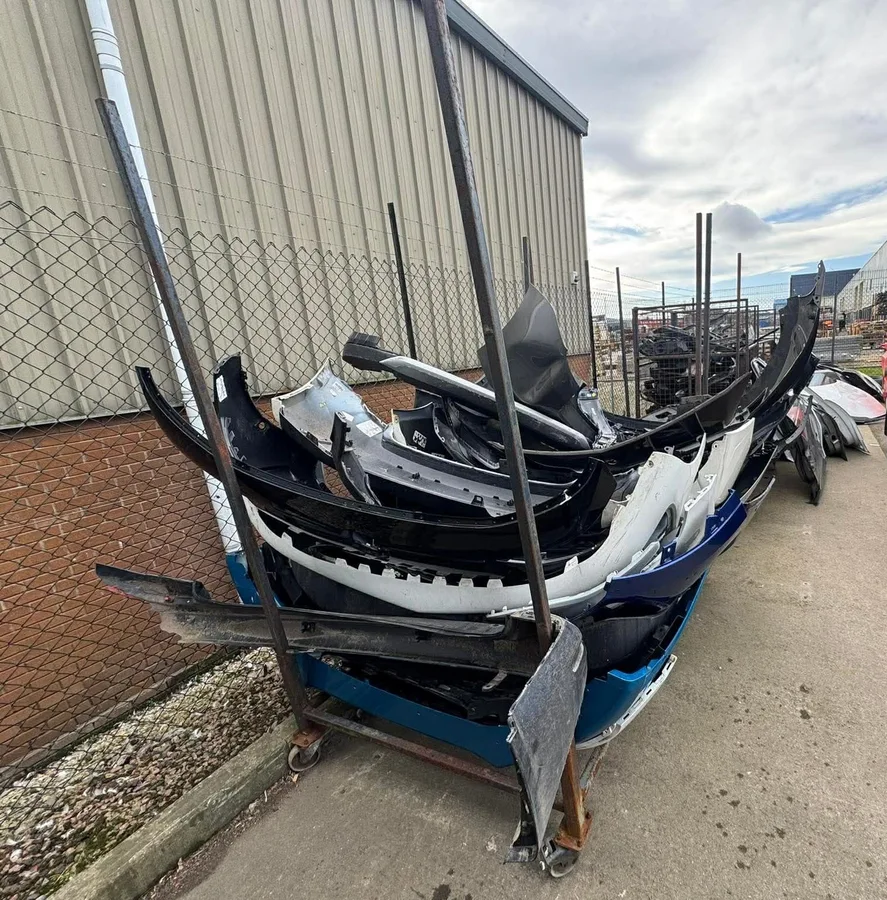
It's one of the most common questions we hear from garages and bodyshops across Scotland — usually asked hopefully, next to a pile of bumpers taking up half the yard. The short answer is no. The longer answer is worth five minutes of your time, because getting it wrong carries real legal and financial risk for your business.
Bumpers are controlled waste
When a bumper comes off a customer's vehicle during a repair, it legally becomes commercial controlled waste — the same classification that covers wheel arch liners, side skirts, trims, grilles and other workshop plastics. That classification matters, because controlled waste comes with legal duties attached from the moment it's created in your workshop.
Under the duty of care in Section 34 of the Environmental Protection Act 1990 — which applies in Scotland just as it does in the rest of Great Britain — any business that produces controlled waste must:
- Store it safely and securely on site until it's collected
- Transfer it only to an authorised waste carrier
- Make sure a waste transfer note is completed for the transfer
- Keep those records so they can be produced if SEPA or your local authority asks
A general builder's skip fails this test in several ways at once. The skip operator may not be authorised to take automotive plastics; the waste gets mixed with incompatible streams; and you typically receive no transfer note describing what left your site. If that waste is later fly-tipped or mishandled, the paper trail stops at your workshop — and the responsibility doesn't transfer just because you paid someone to take it away. Using the wrong carrier does not discharge your duty of care.
What the consequences look like
Breaches of waste duties can result in enforcement action ranging from fixed penalties to prosecution, where fines can be substantial. For bodyshops working with insurers and dealer networks, the commercial consequences can bite even harder than the legal ones: approved-repairer audits increasingly ask for evidence of compliant waste handling, and gaps in your records are an uncomfortable thing to explain mid-audit.
What a compliant route looks like
Compliance is genuinely simple when the right system is in place:
- Segregated storage — bumpers and plastics kept in dedicated bins, cages and bumper racking, not loose or mixed with general waste. We supply these to our collection clients so storage is sorted from day one.
- An authorised carrier — we're registered with SEPA (registration WCR/R/3021810), an authorisation valid across Scotland, England and Wales. You can — and should — verify any carrier on SEPA's public register before they touch your waste.
- A transfer note for every collection — we issue an electronic waste transfer note (eWTN) at every pickup, before our driver leaves, so your compliance file builds itself with zero chasing.
- A legitimate end destination — our collected plastics are granulated into polypropylene regrind and supplied back into manufacturing, not landfilled.
The easy option is also the compliant one
The reason bumpers end up in skips is never malice — it's that the compliant route used to be a hassle. That's the problem we built Eco Auto Solutions to remove. We run scheduled collections — weekly, fortnightly or monthly — for garages, bodyshops and repair centres across Scotland and the North of England down to Carlisle, Penrith and Newcastle, with no minimum volume and the paperwork handled at every visit.
If there's a pile in your yard right now, tell us what you're holding or call 0141 260 6602.
FAQ
Is it illegal to put car bumpers in a general skip? Putting automotive plastics into a route that breaches your duty of care — an unauthorised carrier, no transfer note, or an unlawful destination — can expose your business to enforcement action. The compliant route is a registered waste carrier with a transfer note for every collection.
How do I check if a waste carrier is registered? Search SEPA's public register of waste carriers. Any legitimate carrier will give you their registration number without being asked twice — ours is WCR/R/3021810.
What paperwork should I receive when bumpers are collected? A waste transfer note describing the waste, the parties and the transfer. We issue an electronic waste transfer note (eWTN) at every collection, and you should retain your notes in case SEPA or the local authority asks to see them.
Do damaged or painted bumpers need a different route? No — condition doesn't change the classification. We collect bumpers loose or stacked, cracked or intact, and our operatives strip out unwanted components before granulation.