Cat N vs Cat S: What Insurance Write-Off Categories Actually Mean
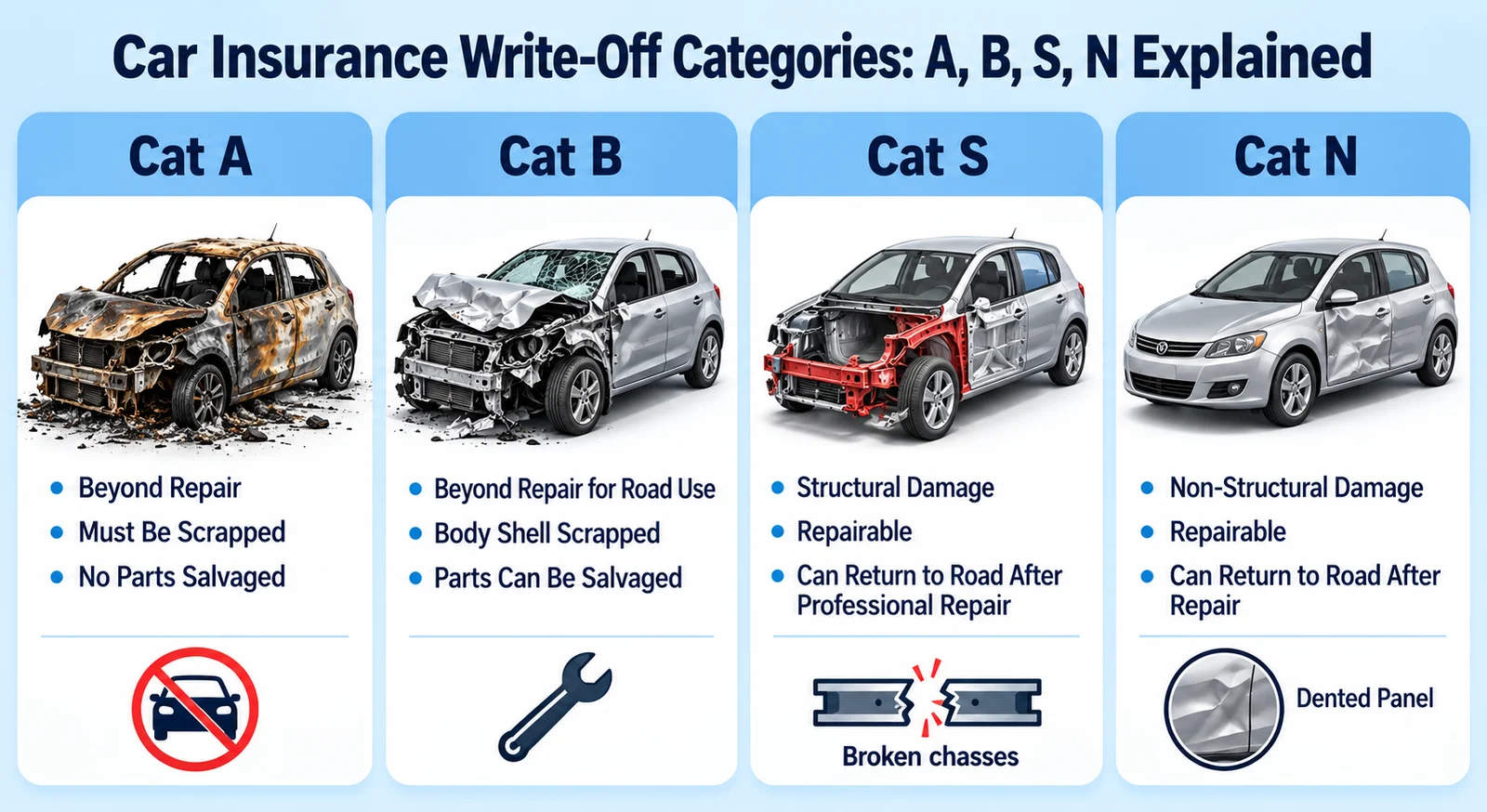
Two letters decide what happens to a crashed car. "Cat N" and "Cat S" get thrown around in auctions, adverts and bodyshop conversations as if everyone agrees on what they mean — yet ask three people in the trade and you may get three different answers. Since the categories shape everything downstream, from whether a car is repaired to where its parts end up, it's worth pinning them down properly.
The four categories at a glance
Insurers in the UK classify written-off vehicles using a salvage code with four categories. A write-off, remember, is an economic judgement, not always a mechanical one: it means the insurer has decided repair doesn't make financial sense, not necessarily that the car is beyond saving.
| Category | What it means | Can it return to the road? |
|---|---|---|
| Cat A | Scrap only — the whole vehicle must be crushed | Never |
| Cat B | Body shell must be destroyed, but parts may be salvaged | Never (parts live on) |
| Cat S | Structural damage, repairable | Yes, after proper repair |
| Cat N | Non-structural damage, repairable | Yes, after proper repair |
The S and N distinction, in plain terms
Cat S means the damage reached the vehicle's structure — the parts of the car that do the load-bearing work in a crash. Repair is permitted, but it is serious work, and the S marker stays on the vehicle's record for life.
Cat N means the structure escaped. The damage sits in non-structural territory: bumpers, panels, lights, trim, cosmetic and bolt-on components — though it can also include electrical or safety-related items, so "non-structural" should never be read as "minor". A Cat N car can carry a surprisingly long repair bill; it simply wasn't worth that bill in the insurer's arithmetic.
The practical consequence: a Cat N vehicle is often a perfectly sound repair prospect, which is why so many pass through bodyshops rather than breakers.
Where the parts go
The categories quietly drive the parts economy. A Cat B vehicle becomes a donor: its undamaged components are recovered before the shell is destroyed. A Cat N repair, meanwhile, consumes parts — and generates waste. The damaged bumpers, broken lights and cracked trims stripped from repairable write-offs are precisely the material a specialist bumper collection service exists to take away, hand-strip and granulate into new raw material.
There's a second, less obvious stream. When an insurer re-scopes a job or writes a vehicle off mid-repair, the brand-new parts ordered for it can be left stranded — genuine OEM components that will never touch the car they were bought for. Those parts aren't waste at all; through a redundant stock purchase they can be bought, paid for and put back into the repair industry instead of depreciating on a shelf.
Why the trade should care about accuracy
Categories travel with the vehicle, and sloppy use of them muddies the water for everyone: a buyer who thinks Cat S is "just cosmetic" is in for a shock, and a seller calling a structural repair "Cat N" is storing up a dispute. If you're buying, check the history; if you're repairing, record what was actually done. The letters only work when they're used precisely.
For bodyshops handling write-off repairs across Scotland and the North of England, the waste side of the job can run as smoothly as the repair side — one call to 0141 260 6602 or a message through our contact page sets up collections for everything the crash left behind.
FAQ
Can a Cat S car be driven again legally? Yes — after it has been properly repaired. The structural damage must be put right, and the Cat S marker remains on the vehicle's record permanently, which is why history checks reveal it.
Is Cat N always cheaper to fix than Cat S? Not necessarily. Cat N only tells you the structure wasn't damaged. Extensive electrical, cosmetic or safety-component damage can make a Cat N repair costly — the category describes the kind of damage, not the size of the bill.
Who decides which category a written-off car gets? The insurer handling the claim assigns the category when it declares the vehicle a total loss, based on an assessment of the damage against the salvage code's definitions.
Does a write-off category ever come off a vehicle's record? No. Once recorded, Cat S and Cat N markers stay with the vehicle for life and appear on history checks, even after a full professional repair.