Bin, Cage or Skip: Which Suits Automotive Bodyshop Waste — and Where Bumper Racking Fits
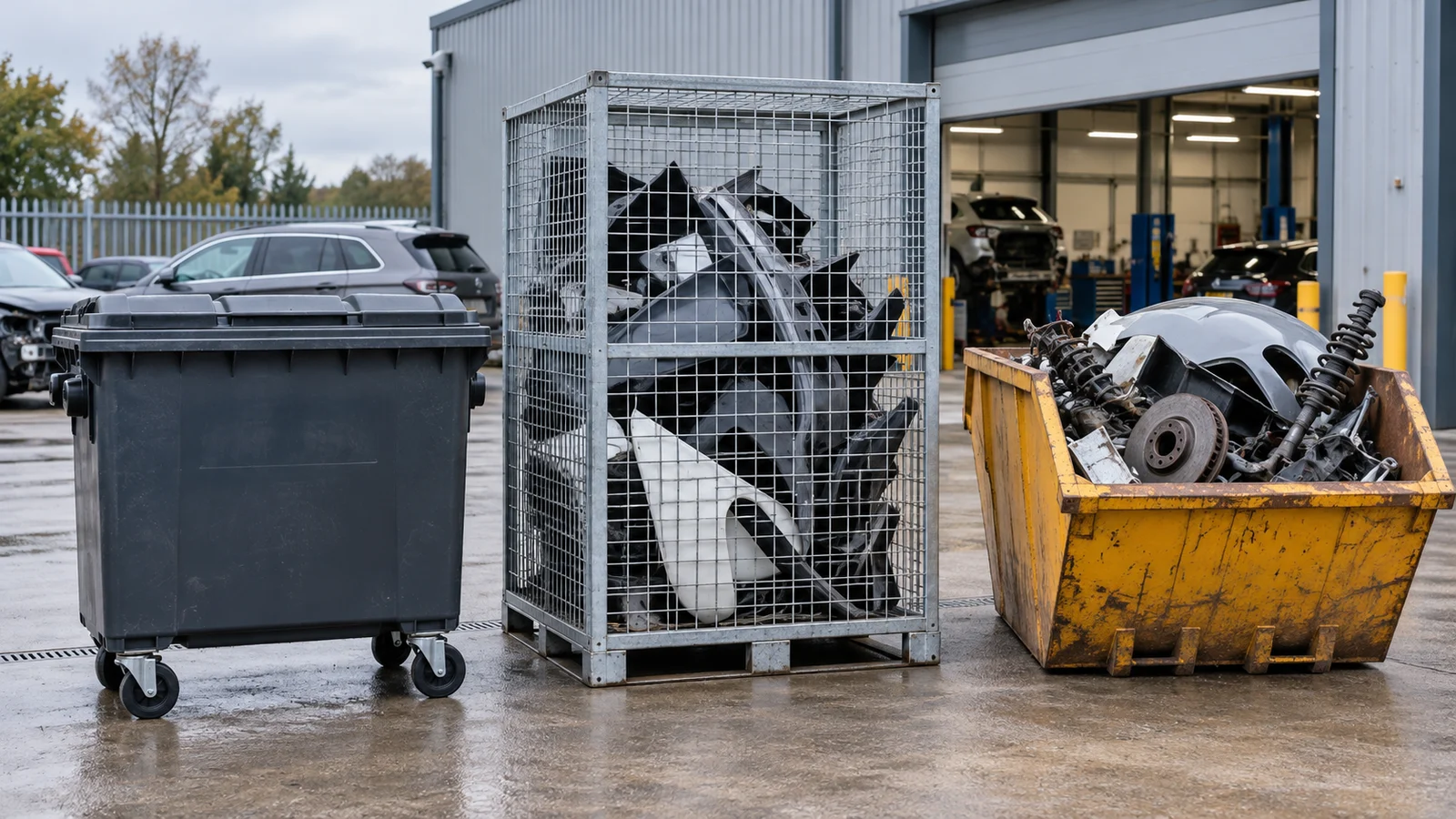
Walk around the back of most bodyshops and you will find one of three answers to the waste question: a hired skip, a collection of bins and cages, or some combination of both with bumpers leaning wherever there is wall. Each container type exists for a reason, but they are not interchangeable — and for the plastic that accident repair work generates, choosing the wrong one quietly costs money and undoes recyclability. Here is how the three options genuinely compare.
The skip: built for the wrong kind of waste
A skip is the right tool for genuinely mixed, heavy, low-value waste — rubble, fittings from a refit, true general refuse. For automotive plastics it fails on three counts.
First, geometry. Bumpers and arch liners are bulky and light, so they fill a skip's volume long before they trouble its weight limit. A skip full of air-filled plastic shapes is an expensive way to move very little material, and skip hire is typically charged per lift regardless of how little the load weighs.
Second, recyclability. The moment a bumper lands in a mixed skip alongside oily rags, metal offcuts and general refuse, it stops being clean polypropylene feedstock and becomes contaminated mixed waste. Plastic that could have been granulated into regrind is instead dragged down to the value of whatever it is touching — a one-way door that no sorting facility fully reverses.
Third, your duty of care. Under section 34 of the Environmental Protection Act 1990 — which applies across England, Scotland and Wales — a business must take reasonable steps to ensure its waste is handled properly. Segregating a clean, recyclable stream and sending it down a recycling route is a much easier story to stand behind than tipping everything into one container, whether your regulator is SEPA in Scotland or the Environment Agency in England.
Bins and cages: the right scale for a segregated stream
Once plastics are kept as their own stream, the choice between bin and cage comes down to what the material is. Choose a bin for small, dense items — trims, grilles, brackets, hard-plastic offcuts — where containment and mobility matter most; a bin can live beside the workstation that fills it and be wheeled out when the van arrives. Choose a cage where the material is bulky and awkward — wheel arch liners, side skirts, headlights and soft plastics — because a cage holds volume in a fixed footprint and keeps light material from migrating around the yard.
The pairing works because it mirrors how a workshop actually produces waste: lots of small pieces at the bench, fewer large pieces per job. Most sites end up with both, positioned where the work happens rather than where the skip company could drop a container.
Where bumper racking fits
Bumpers deserve their own answer, because they fit neither container well: too long for bins, wasteful of cage space, and vulnerable to damage when heaped. Bumper racking solves the specific problem a bumper poses — it stores each unit vertically and separately, so a full day's removals occupy a strip of wall rather than a quarter of the yard, and a good-condition bumper stays good. That last point matters more than it looks: bumpers that survive storage undamaged can be refurbished and resold as used parts rather than granulated, which is the better outcome for a serviceable part.
You choose the collection, not the containers
With Eco Auto Solutions, the container question largely answers itself: bins, cages and bumper racking are supplied to collection clients as part of the service, matched to what your site produces. The material they hold goes down a genuine recycling route — our plastic waste collection and bumper collection streams are hand-stripped and granulated into PP regrind, with nothing to landfill — and every visit comes with an electronic waste transfer note issued before the driver leaves. You can read more about the bins, cages and bumper racking we supply.
Collections run weekly, fortnightly, monthly or as one-offs, with no minimum volume, across all of Scotland and the North of England. Contact us or call 0141 260 6602 to work out the right setup for your yard.
FAQ
Can I just put bumpers and plastics in my general waste skip? You can, but it wastes skip capacity on bulky, light material and contaminates plastic that could otherwise be recycled into PP regrind. A segregated plastics stream is better for cost and compliance alike.
When is a cage better than a bin? Use a cage for bulky, awkward items — arch liners, side skirts, headlights and soft plastics. Bins suit small, dense pieces like trims and grilles that benefit from containment near the workstation.
Is bumper racking really necessary, or will a cage do? A cage will hold bumpers, but inefficiently and with a risk of damage. Racking stores them vertically and individually, saving floor space and protecting good-condition bumpers for refurbishment and resale.
Do I have to buy the bins, cages and racking myself? No. Eco Auto Solutions supplies bins, cages and bumper racking to its collection clients, sized to the material the site produces.