A Bodyshop Compliance Checklist: What to Have in Place Before an Inspection
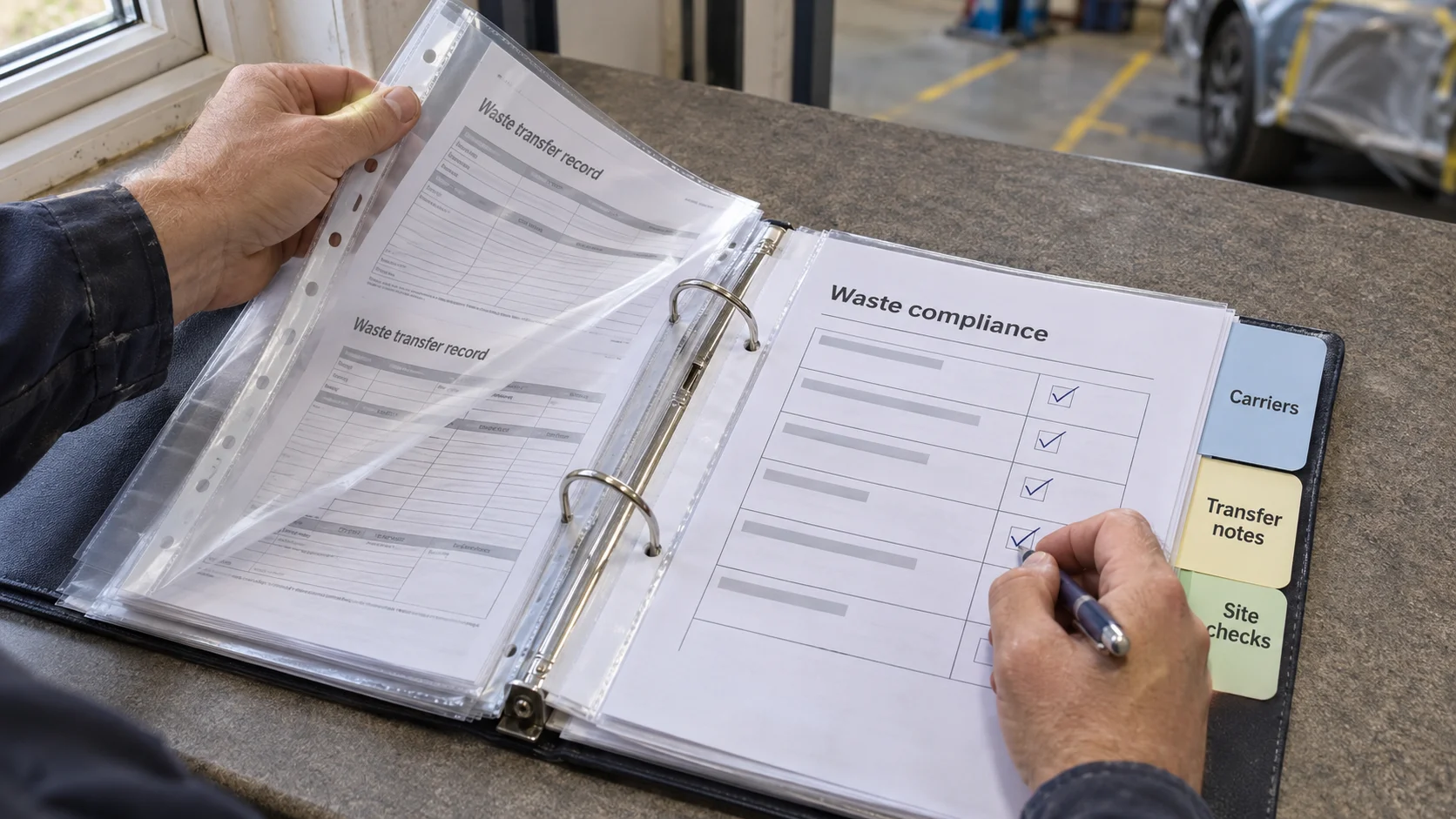
Nobody prepares for an inspection during the inspection. By the time someone from SEPA (in Scotland) or the Environment Agency (in England) is standing in your yard, your compliance position was settled weeks ago — by the paperwork you did or didn't file, the contractor you did or didn't check, and the state the waste area was in on an ordinary Tuesday. The good news is that the whole position can be put right in advance, and most of it in an afternoon. Run this checklist against your own site and tick honestly.
1. You can show every waste carrier is registered
The duty of care under section 34 of the Environmental Protection Act 1990 applies across Scotland, England and Wales, and it makes your business responsible for handing waste only to someone authorised to take it. That means, for every contractor who removes anything from your site, you hold evidence of a current carrier registration — and you've actually looked it up, because verifying a waste carrier on the public register takes minutes and an invoice with a logo proves nothing. Eco Auto Solutions, for the record, invites exactly this check: registration WCR/R/3021810, visible on SEPA's public register and valid across Scotland, England and Wales.
2. Your transfer notes exist, and you can find them
Every movement of waste off site should be covered by a transfer note, and the standard to work to is keeping them for two years. The test an inspector applies is simple: pick a date, produce the paperwork. A drawer of loose dockets fails that test even when every docket exists. Electronic notes solve the filing problem at source — our own collections come with an eWTN issued before the driver leaves, so the record is created at the moment of transfer rather than reconstructed later.
3. Your waste descriptions actually describe your waste
A transfer note that says "general waste" over a load of bumpers, thinners tins and mixed workshop refuse describes nothing. Waste must be classified and described accurately — the right category, the right description, hazardous streams identified as such. If your paperwork has been copying last year's wording unread, this is the item to fix first, because a wrong description quietly invalidates otherwise tidy records.
4. Hazardous and non-hazardous streams never share a container
Paint waste, solvents, contaminated rags and oily items live in a different legal category from clean plastics, metals and cardboard — and mixing them upgrades the whole container to the stricter regime. An inspector will look in the bins before reading any file. Separate, labelled containment for each stream, with lids and bunding where the contents call for it, is the physical half of compliance.
5. Recyclable streams are genuinely segregated
Beyond the hazardous line, segregation is what turns waste into material. Bumpers, trims and liners kept as their own clean stream can be collected for recycling rather than disposal — a dedicated plastic waste collection only works if the plastics aren't buried in general waste. Proper containment helps here too, and collection clients get bins, cages and bumper racking supplied for the purpose, so segregation doesn't depend on improvised storage.
6. The waste area would pass a glance test today
Secure containers, nothing escaping in the wind, no liquids tracking to a drain, waste not accumulating beyond what your storage sensibly holds. An inspector reads the yard as evidence of the system behind it — a tidy, contained waste area buys credibility for everything in your file.
7. Someone owns all of the above
The most common failure isn't a missing document; it's that nobody knows who keeps it. Name one person who holds the carrier evidence, files the notes, and walks the waste area monthly. Compliance that belongs to everyone belongs to no one.
Five minutes per item, seven items, and you're ahead of the knock on the door. If item 1 or 5 is where your gaps are, Eco Auto Solutions can close both — a registered carrier collecting segregated automotive plastics across all of Scotland and the North of England, including Carlisle, Penrith, Newcastle, Middlesbrough, York, Leeds, Bradford, Manchester and Liverpool. Talk it through on 0141 260 6602 or via our contact page.
FAQ
Do SEPA or the Environment Agency inspect bodyshops unannounced?
They can. Visits may be routine, triggered by a complaint, or part of a themed campaign, and notice isn't guaranteed. That's the practical argument for keeping the site inspection-ready as a standing condition rather than preparing for a date.
Is the checklist different in Scotland and England?
The regulator differs — SEPA in Scotland, the Environment Agency in England — and some procedural details vary, but the duty of care itself applies across Scotland, England and Wales, so every item on this list holds on both sides of the border.
What should we do if we discover a contractor isn't registered?
Stop using them for waste movements until they can show current registration, and check the public register yourself rather than accepting a promise that it's "being renewed". Past movements can't be undone, but the duty of care is ongoing — the fix is to correct the arrangement from today and document that you did.
Who is responsible if our waste is fly-tipped after it leaves our site?
Responsibility doesn't end at your gate. If you handed waste to an unauthorised carrier, or described it so poorly it couldn't be handled properly, your duty of care is engaged even though someone else did the dumping. Checked registration and accurate transfer notes are precisely what shows you discharged your side.