EWC Codes for Automotive Waste, Explained Simply
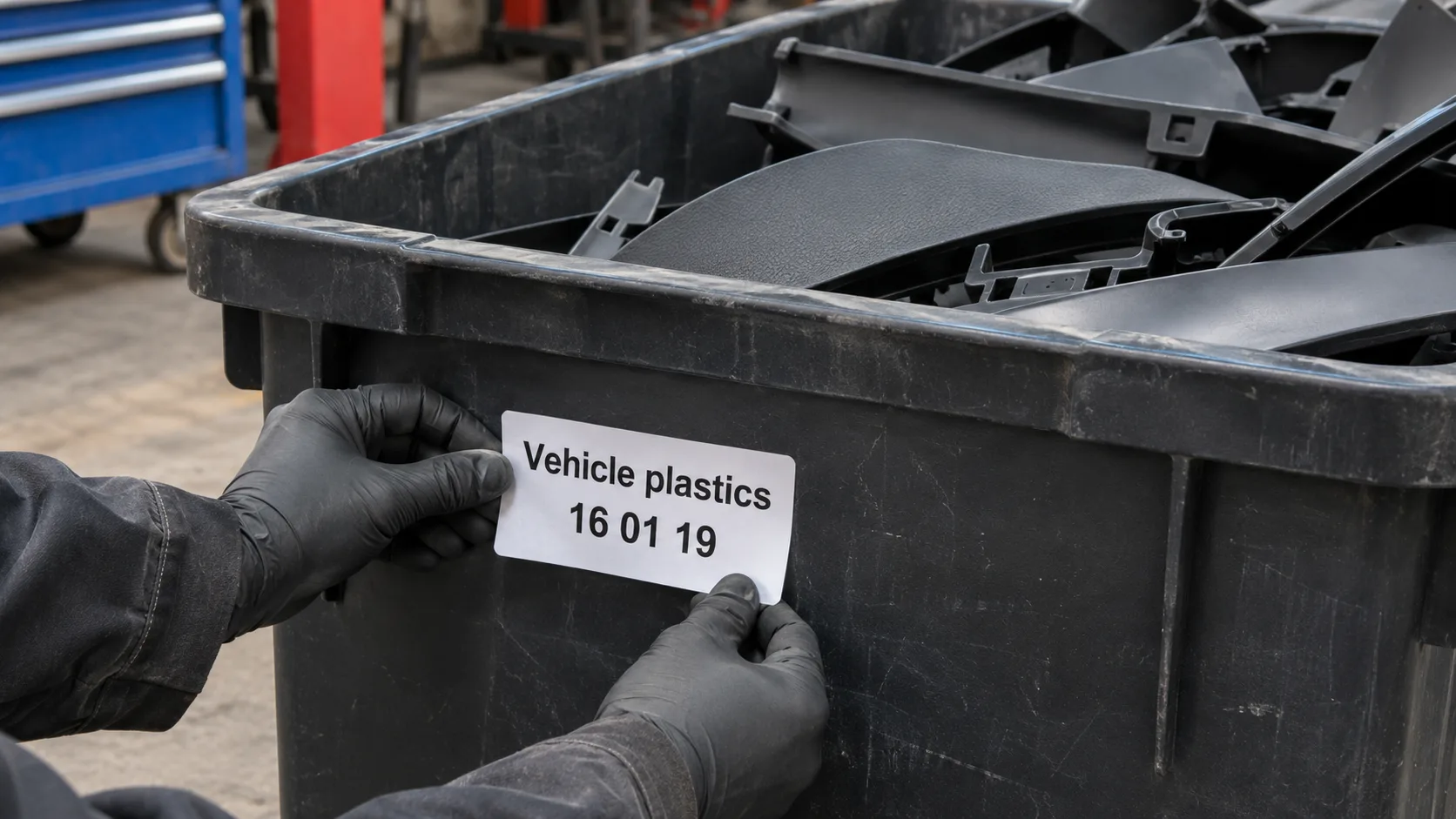
16 01 19. If you've ever glanced at the paperwork from a plastics collection, you've seen a number like that sitting next to the description — and if you've ever wondered whether it matters or who checks it, this is the article. EWC codes look like bureaucratic wallpaper, but they're actually a tidy little system, and reading one takes about thirty seconds once you know the trick. Here's how, in five steps.
Step 1: Know what the code is doing
EWC stands for European Waste Catalogue — also called the List of Waste — and it's the standard classification system used across the UK to say what a waste actually is. Every waste transfer note needs a written description of the waste plus its code, because "old plastic bits" means something different in every yard, while 16 01 19 means the same thing to you, your carrier, the site that receives the material and the regulator reading the file two years later. Getting the code right is part of describing your waste properly under the duty of care, which applies to every garage and bodyshop in Scotland, England and Wales.
Step 2: Read the six digits in pairs
The code is three pairs, read left to right, going from general to specific. The first pair is the chapter — broadly, the industry or process the waste comes from. The second pair narrows it to a sub-chapter, and the final pair names the specific waste. Most of what a garage or bodyshop produces from vehicles sits in chapter 16, and specifically in 16 01: wastes from end-of-life vehicles and from vehicle maintenance. So 16 01 19 unpacks as: chapter 16, vehicles sub-chapter 01, entry 19 — plastic. That's the code that follows a load of bumpers and trims out of your yard.
Step 3: Look for the asterisk
Some codes carry an asterisk — 16 01 07*, for example, for oil filters. The asterisk means the entry is classed as hazardous waste (called special waste in Scotland), which triggers stricter handling and documentation. This is the single most useful thing the code tells you at a glance: a starred code can never travel on ordinary paperwork with an ordinary load, however small the quantity. If you only remember one feature of the system, remember the asterisk.
Step 4: Watch for mirror entries
Some wastes appear twice in the catalogue — once with an asterisk and once without — because whether they're hazardous depends on what's actually in them. The classic workshop example is absorbents and wipes: rags soaked in oil or solvent take the starred entry, while clean equivalents take the unstarred one. Mirror entries are where honest classification matters most, because the same physical object can legitimately carry either code depending on its condition, and the person filling in the paperwork is the one making that call.
Step 5: Match the common codes to your streams
A typical garage or bodyshop meets a fairly short list. Plastics from vehicles — bumper covers, wheel arch liners, trims, grilles — travel as 16 01 19. Ferrous and non-ferrous metals from vehicles have their own 16 01 entries, which is where alloy wheels sit. Tyres have one. Packaging has its own chapter entirely (15), which is why a plastic parts box doesn't share a code with the bumper that came in it. And the workshop's hazardous regulars — oils, oil filters, brake fluids, lead-acid batteries, solvent-laden paint wastes — all carry starred codes from their own chapters. Treat any list like this as a starting point, not gospel: confirm codes against official guidance or with your carrier, because the composition of your stream is what decides.
Who gets it right for you
In practice, classification is a conversation between producer and carrier — and a competent carrier makes it easy. A segregated stream arrives already matching its code: a dedicated plastic waste collection means your liners, trims and skirts leave as clean 16 01 19 material rather than something a receiving site has to argue about, and the same goes for a bumper collection that never mixes with general waste. The other half of the conversation is checking who you're talking to — it takes minutes to verify a waste carrier on the public register before their code choices appear on your paperwork.
If you'd like your streams, codes and documentation to line up without the homework, that's the job we do every day across all of Scotland and the North of England. Call 0141 260 6602 or ask us about your streams.
FAQ
What happens if the wrong EWC code goes on a transfer note?
The note misdescribes the waste, which undermines the duty of care it exists to evidence — and if a non-hazardous code is used for material that should carry a starred one, the waste may be handled and received at sites not permitted to take it. Spotted errors should be corrected with the carrier and the receiving site rather than quietly left in the file.
Can one code cover a mixed load?
Only if the load is genuinely one waste type. A mixed load either needs each component classified — which is why transfer notes can list multiple codes — or it ends up under a vague mixed-waste description that's worth less to everyone and invites questions. Segregating at source is usually easier than classifying a jumble afterwards.
Who is responsible for choosing the code — the garage or the carrier?
The duty of care makes the producer responsible for describing their waste accurately, but in practice a reputable carrier will agree the classification with you, because they and the receiving site rely on it too. Be wary of any arrangement where nobody seems to decide and the code just appears.
Are EWC codes still used in the UK after Brexit?
Yes. The List of Waste was retained in UK law, so the same six-digit codes remain the working classification across Scotland, England and Wales, and SEPA and the Environment Agency both expect them on waste documentation. The name on the tin is European; the obligation is domestic.