Setting Up Waste Handling in a New Bodyshop: Six Steps Before Day One
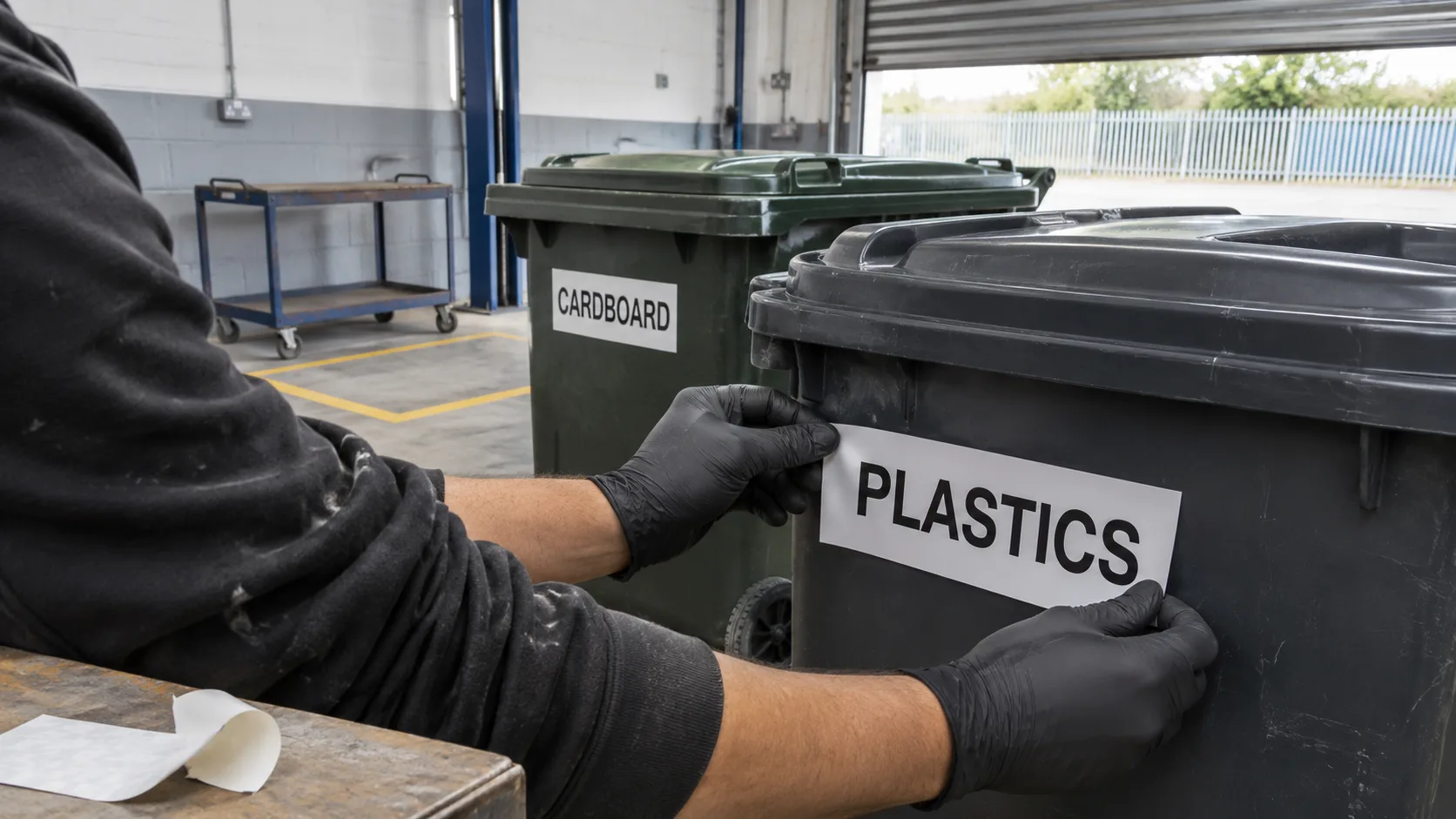
Fit-out plans for a new bodyshop lavish attention on the booth, the bench and the mixing room, and waste gets a line that says "skip". Then the first month happens: a corner fills with bumpers nobody has a route for, paint tins mix with trim offcuts, and the paperwork question arrives the first time anyone official looks around. Every one of those headaches is avoidable if waste is treated as part of the fit-out. Here are the six steps, in the order to take them.
Step 1: List your streams before you open
A repair business produces distinctly different kinds of waste, and the whole system flows from naming them early. There will be hazardous streams — paint and lacquer residues, thinners, contaminated wipes and masking, aerosols — and non-hazardous ones: plastic bumpers and trims, damaged headlights, cardboard and packaging, metal offcuts, alloy wheels past saving. Hazardous and non-hazardous streams need separate routes and must never share a container. Write the list down; it becomes your specification for everything that follows.
Step 2: Know who regulates you and what you owe
Wherever you are in Britain, the duty of care under section 34 of the Environmental Protection Act 1990 applies from your first job: you're responsible for your waste from the moment it arises until it's transferred to someone authorised to take it, with a proper description. In Scotland your regulator is SEPA; in England it's the Environment Agency. Neither expects a new business to be perfect — both expect it to know its duty of care and be able to show the basics are in hand.
Step 3: Choose carriers you've actually checked
Every contractor who takes waste off your site should be a registered carrier, and registration is publicly checkable in minutes — here's how to verify a waste carrier on the public register before signing anything. Do this at setup, when there's no pressure, rather than after a pile has built up and anyone with a van looks tempting. For reference, our own registration is WCR/R/3021810, verifiable on SEPA's register and valid across Scotland, England and Wales.
Step 4: Build storage into the floor plan
Waste storage decided after the racking goes in ends up wherever's left — usually somewhere that blocks a roller door. Instead, allocate space per stream while the layout is still on paper: covered, contained storage for hazardous materials, and dedicated containers for recyclable plastics so they stay clean and uncrushed. You shouldn't need to buy the plastic-side equipment: we supply bins, cages and bumper racking to collection clients, sized to the streams you listed in step one.
Step 5: Set a schedule, not a panic response
A new shop can't predict its volumes, which is an argument for a flexible arrangement rather than no arrangement. A plastic waste collection can run weekly, fortnightly, monthly or as a one-off, with no minimum volume — so a quiet first quarter costs you nothing in wasted visits, and a busy one doesn't bury the yard. Book the hazardous-waste contractor on the same principle. The goal is that waste leaves on a rhythm, not when someone finally snaps.
Step 6: Start the audit file on day one
Every transfer of waste generates a document — a transfer note, or in our case an eWTN issued at every collection before the driver leaves. Keep them all, organised by stream and date, working to the standard two-year retention for transfer notes. A file that starts complete stays complete; one that starts "we'll sort it later" never quite catches up, and it's the first thing an inspector asks for.
Setting up in Scotland or the North of England — Carlisle, Penrith, Newcastle, Middlesbrough, York, Leeds, Bradford, Manchester, Liverpool and everywhere between? We'll set up the plastics side before you open your doors: get a collection arranged or call 0141 260 6602.
FAQ
Does a new bodyshop need its own waste carrier registration?
Only if you'll transport waste yourself — running your own offcuts to a transfer station in the shop van, for example. If registered contractors collect everything from site, their registration covers the carriage; yours would cover your own wheels. Many new shops register anyway because it's inexpensive and keeps the option open.
We're fitting out now — how much space should waste storage get?
Think in streams, not square metres: one secure, covered spot for hazardous materials away from drains, one zone for plastics in cages or racking, one for general waste, positioned so a collection vehicle can reach them without threading through the workshop. A tight site is workable if the layout is deliberate; the expensive mistake is leaving it to chance.
Can we wait until we're busy before setting up collections?
You can, but the early weeks are exactly when habits form. If the first bumpers off the ramp go in a cage, every bumper after them does too; if they go in the corner, the corner becomes policy. Flexible schedules exist so that low early volumes aren't a reason to delay the system.
What's the first thing an inspector would ask a new shop for?
Typically evidence of the basics: what wastes you produce, who takes each stream, proof those carriers are registered, and your transfer notes. A thin file that's accurate and current makes a far better impression than a thick one assembled retrospectively.