Genuine OEM vs Aftermarket Parts in Accident Repair: The Real Differences
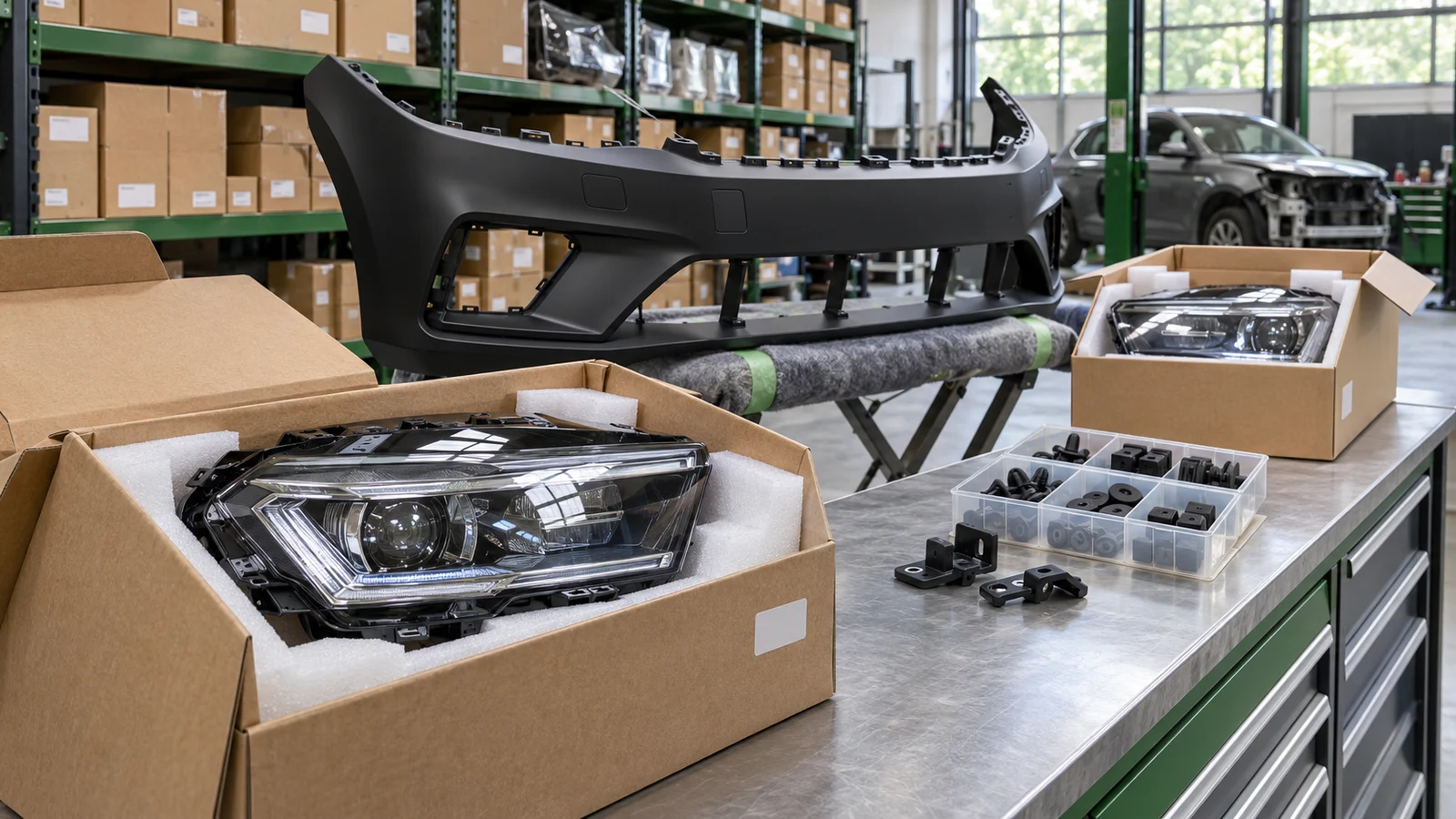
Line four of the estimate reads "front bumper". What it doesn't say is which front bumper — the one in the carmaker's box, or one of several lookalikes made by somebody else entirely. For the car owner the difference is invisible on paper; for the repairer it shapes the job; for the insurer it shapes the claim. Here is what the labels actually mean, and where the differences genuinely bite.
The terms, untangled
Genuine OEM parts are made by or for the vehicle manufacturer, to the same specification as the part fitted on the production line, and sold in the manufacturer's packaging through its parts network. Aftermarket parts are made by independent manufacturers. The aftermarket is not one thing: at its best it includes parts built to match the original specification, some certified as such by independent testing bodies; at its cheapest it includes parts whose resemblance to the original is mostly visual.
Side by side
| Genuine OEM | Aftermarket | |
|---|---|---|
| Origin | Made to the carmaker's own specification | Made by independent manufacturers, to standards that vary widely |
| Fit | Designed for the exact model and variant; tabs, clips and tolerances match | Often good, sometimes approximate — adjustment and fettling may be needed |
| Finish | Consistent substrate and priming; predictable paint behaviour | Variable; some panels paint beautifully, others fight the painter |
| Cost | Typically the most expensive route at dealer list price | Generally cheaper, which is its core appeal |
| Assurance | Backed by the manufacturer's own quality system | Ranges from independently certified to entirely unverified |
| Availability | Tied to the dealer network and its lead times | Often held widely, sometimes faster to source |
Where the differences actually bite
On a steel door skin, a well-made aftermarket panel may serve perfectly well. The gap widens on precisely the parts accident repair uses most.
Bumpers carry more engineering than they appear to: mounting tabs, energy absorbers, and apertures for sensors and washers all sit within tight tolerances. A cover that is a few millimetres off turns a bolt-on job into an afternoon of adjustment, and panel gaps advertise the compromise forever.
Headlights are the sharpest case. A modern unit is an optical instrument, and beam pattern, aim and light output are exactly where cheaper copies most often fall short — differences a driver only discovers on an unlit road.
Sensor-laden panels raise the newest question. Many bumpers now sit in front of radar and parking sensors, and driver-assistance systems are calibrated around the original panel's exact geometry and material. The wrong part can mean a system that calibrates grudgingly or not at all.
What the paperwork expects
Insurance policies differ on which parts a repair may use, and repairers working to recognised repair standards are expected to restore the vehicle to its pre-accident condition using appropriate parts and methods. The practical rule for a bodyshop is transparency: know what the policy specifies, record what was fitted, and make sure the customer isn't discovering the answer later.
The third route: genuine OEM, without dealer list price
The table above hides a quiet assumption — that genuine means paying full dealer price. It doesn't have to. Across the UK, garages and dealer parts departments sit on unused genuine OEM stock: parts ordered for jobs that changed, superseded numbers, over-ordered lines still boxed on the shelf. That stock re-enters the market through the surplus trade — genuine manufacturer parts, unused, at prices the aftermarket usually competes with on nothing but price.
Eco Auto Solutions sits on both sides of that flow. Through our redundant stock purchase service, garages send a photo of unused genuine parts and get an offer within 24 hours, with the stock collected alongside their next pickup. Those parts are resold through EAS Parts — genuine OEM only, shipped UK-wide — so a repairer can fit the part the car was built with, below the dealer counter price. And when the damaged original comes off the car, the same visit can take it away: our headlight collection and plastics service runs across all of Scotland and the North of England. Got boxed stock gathering dust, or a parts question for a live job? Call 0141 260 6602 or send us the details.
FAQ
Is it legal to fit aftermarket parts in an insurance repair?
Yes — aftermarket parts are legal, and widely used. The constraints are contractual and professional rather than legal: what the policy allows, what the repair standard requires, and what the customer has agreed to.
What does "matching quality" mean on an aftermarket part?
It describes a part made to the same specification as the original, and the stronger claims are backed by independent certification bodies that test parts against the OEM equivalent. An uncertified part may still be good — but the claim is the manufacturer's own.
Why would a genuine OEM part be available below dealer price?
Because it's surplus: bought through the dealer network for a job that never used it, then sold on rather than written off. The part is identical to dealer stock — same manufacturer, same box — only its journey to the shelf differs.
Do aftermarket panels affect driver-assistance systems?
They can. Radar and camera systems are calibrated around the geometry and material of the original panels, particularly bumpers. Any replacement panel — genuine or aftermarket — should be followed by the calibration the vehicle maker specifies, but dimensionally accurate parts make that calibration far more likely to succeed first time.