Parts Delays in Accident Repair: Causes and Practical Workarounds
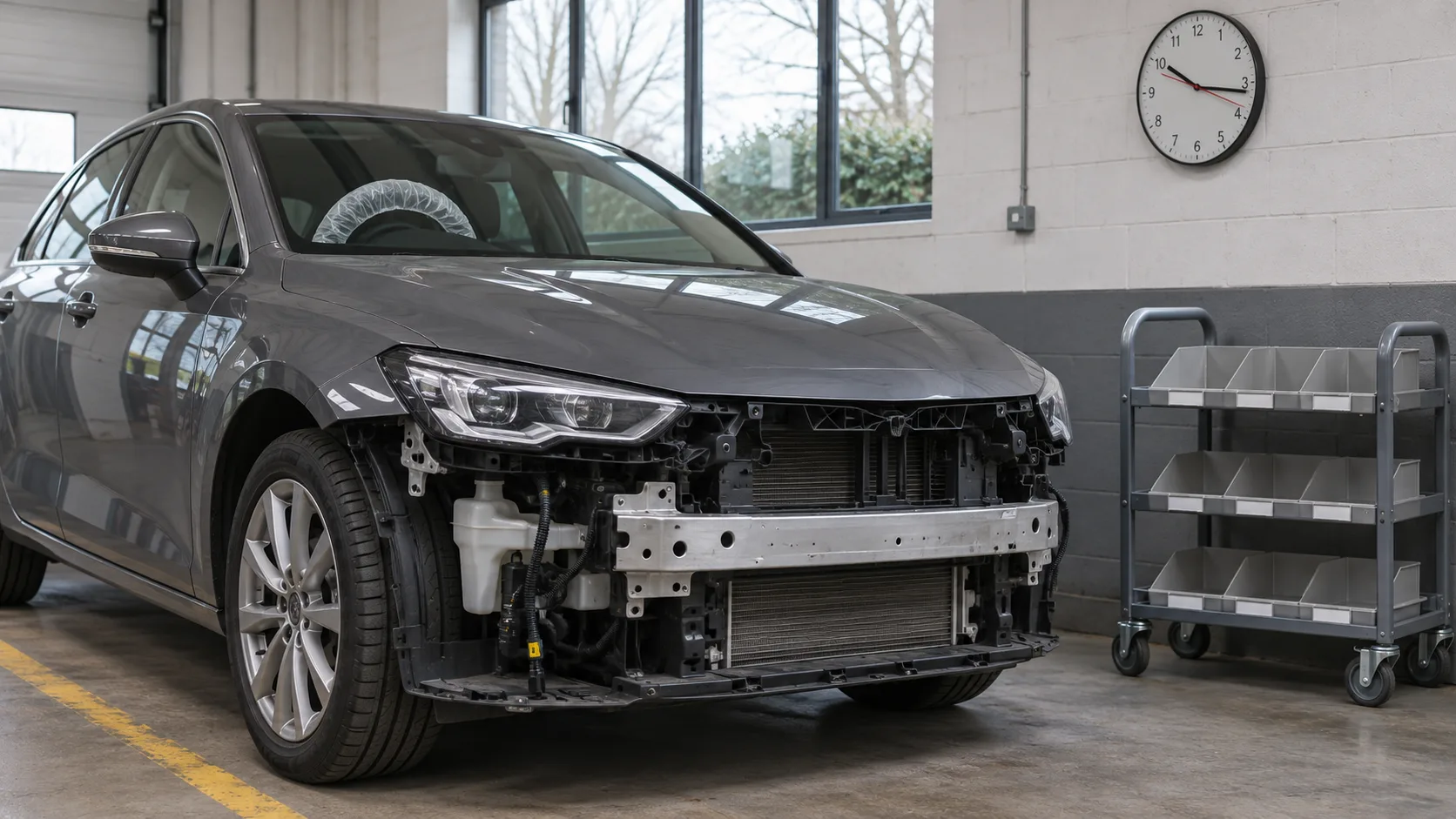
The most expensive space in a bodyshop is the one occupied by a car nobody can work on. The ramp earns nothing, the courtesy fleet shrinks by one, the customer rings for an update — all because a box hasn't arrived. Parts delays are the repair industry's weather: nobody controls them, but well-run shops are noticeably better dressed for them.
Why parts run late in the first place
A few forces stack up. Modern repairs need more parts per job than they used to — a bumper assembly now brings sensors, brackets, absorbers and a scatter of one-time-use clips, and one missing clip can hold a finished car hostage. Distribution runs through long chains, so a part out of stock nationally is out of stock for every repairer at once. Part numbers get superseded mid-order, and model changeovers can put a single component on back order for weeks. None of this is any one supplier's fault, which is why waiting harder isn't a strategy.
The checklist well-prepared shops run
Identify everything before you order anything
A visual estimate orders the parts you can see; the strip reveals the ones you couldn't. Shops that strip and mirror-match the full parts list before ordering make one order per job instead of two — and it's the second, mid-repair order that does the real damage to key-to-key times.
Book the car in when the parts land, not before
A vehicle waiting at home costs a phone call; a vehicle waiting stripped on site costs a bay, a courtesy car and a customer's patience. Where the damage allows it, scheduling around confirmed parts arrival turns a supply problem into a diary entry.
Chase supersessions at the point of order
If the number on the estimate and the number in the box don't match, find out why before the van leaves the supplier. A superseded number caught at ordering is a line edit; caught at fitting, it's a reorder and a lost week.
Keep more than one sourcing route open
The official channel is one route, not the only one:
| Route | What you get | Where it shines | Watch-out |
|---|---|---|---|
| Franchised dealer order | The current genuine part | Latest revision, guaranteed fit | A national back order stops this route for everyone at once |
| Trade-surplus genuine | Unused genuine OEM stock from elsewhere in the trade | The identical part, new and boxed, sometimes available when the channel shows weeks | Confirm the part number and any supersession |
| Aftermarket equivalent | A pattern part built to match | Often held closer to hand | Fit and finish vary; work-provider rules apply |
| Refurbished original | A professionally restored unit, common with bumpers | Panels where refurbishment is well proven | Condition grading matters — buy from someone who grades honestly |
Trade-surplus stock deserves more attention than it gets. Dealers and garages routinely over-order, and those unused genuine parts don't vanish — businesses like ours buy that redundant stock and return it to the market through EAS Parts, genuine OEM only, shipped UK-wide. For a repairer staring at a back order, it's the same part by a different road.
Tell the customer and the work provider early
A delay reported on day one is logistics; the same delay discovered by the customer on day ten is a complaint. Early, specific updates — what's late, why, and the realistic date — protect the relationship.
Watch the economics clock
A repair that drags accumulates cost around it, and on a borderline vehicle that arithmetic — not the damage itself — can be what separates repair from write-off, the territory of Cat N and Cat S categories. On marginal jobs, a tight parts timeline is what keeps the repair viable at all.
The other side of the same coin
Every delayed part a repairer hunts for is sitting unused on someone else's shelf. If some of that surplus is yours, photograph the stock and we'll make an offer within 24 hours — send us the shelf or call 0141 260 6602.
FAQ
Why do genuine parts sometimes take longer to arrive than aftermarket ones?
Genuine parts flow through the manufacturer's own distribution tiers, so when national stock is exhausted, every franchised outlet waits together. Aftermarket suppliers run independent stock on independent logistics, which is why the two routes rarely fail at the same time.
Is a trade-surplus genuine part different from the one the dealer would supply?
No — it's the same manufacturer's part, new, unused and boxed; only the road it travelled differs. The checks are the same as for any order: the part number, any supersession, and that the seller deals in genuine stock rather than lookalikes.
Why did the part number change between the estimate and the order?
Manufacturers revise components continually — improved designs, consolidated variants — and each revision can retire the old number in favour of a new one. Estimating systems don't always catch up instantly, which is why confirming the live number at ordering saves the reorder later.
Can a parts delay really push a car into being written off?
On a marginal case, yes — the decision weighs total claim cost against the vehicle's value, and a long delay adds cost around the repair even when the parts bill doesn't move. Speed of supply is an economic issue for everyone in the claim, not just an inconvenience.