How Bodyshops Can Show Customers and Insurers Their Waste Is Handled Responsibly
"Where does the old one go?" A few years ago that question came up rarely, and a vague answer ended it. Now it arrives from two directions at once: customers who care what happens to the bumper that came off their car, and insurers whose own sustainability commitments are flowing down into questionnaires for their repair suppliers. "It gets recycled" no longer lands unless you can show it. The good news is that showing it takes evidence you can assemble in an afternoon. Here's how, in five steps.
Step 1: verify your carrier — and keep the proof
Everything downstream rests on who takes your waste, so start there. Every carrier should hold a registration you can check on the regulator's public register — SEPA's for Scotland, the Environment Agency's for England. Search the carrier's name or registration number, screenshot or print the entry, and date it. Eco Auto Solutions' registration (WCR/R/3021810) is verifiable on SEPA's public register in under a minute, and any carrier worth using will point you to theirs just as readily. That single dated page is the foundation of the file: it shows you checked, not just assumed.
Step 2: capture a document at every handover
Each time waste leaves your site, a transfer note should exist naming what the load was, who took it and when — with two years' retention as the standard to work to. This is also where the duty of care you already carry as a producer gets its paper trail. The format matters more than people think: electronic notes beat paper because they arrive filed and searchable instead of fading in a cab. Our collections generate an eWTN before the driver leaves, which means the evidence file grows by itself, one collection at a time, with nobody photocopying anything.
Step 3: be able to name the end destination
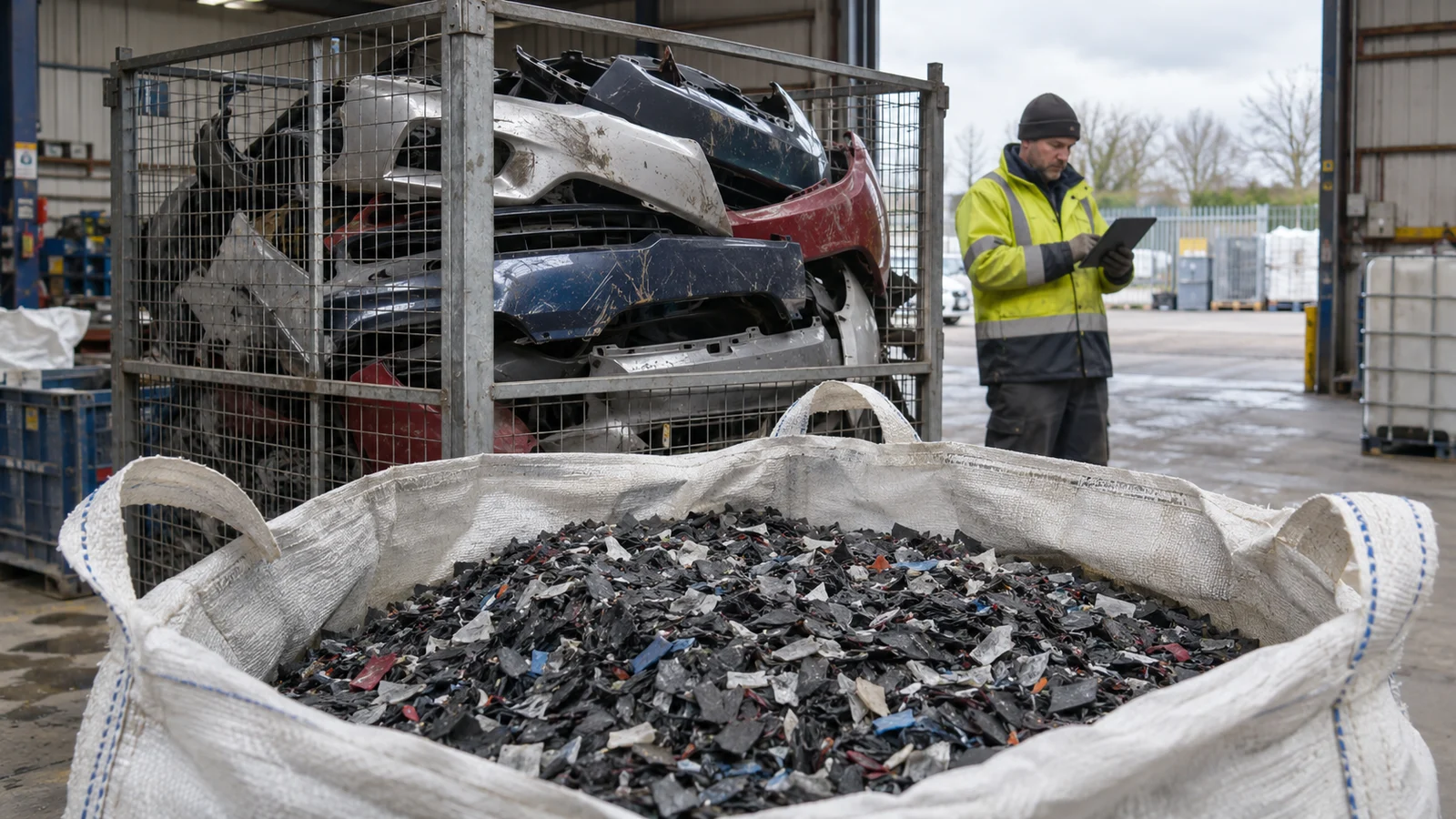
A transfer note proves the waste left responsibly; it doesn't say what became of it. The strongest answer to a customer or an insurer names the outcome, not just the handover. For plastics that answer can be specific: bumpers and trims collected through our bumper collection are hand-stripped, granulated into PP regrind and supplied back to manufacturing, with nothing going to landfill. Ask every contractor you use the same question — "what does this become?" — and write the answer into your file. A contractor who can't answer it is telling you something.
Step 4: make the yard agree with the file
An inspector, an insurer's engineer or a customer peering past reception will believe what they see before what they read. Labelled, segregated containers that match the streams in your paperwork turn the file from a claim into a description. It needn't be elaborate — bumpers racked rather than heaped, plastics in their own cage, hazardous materials visibly apart. If the pile and the paperwork tell the same story, every other question gets easier.
Step 5: turn the file into answers people can use
Evidence that sits in a folder convinces nobody. Distil it into a one-page summary: who collects each stream, their registration, what each stream becomes, and the date you last verified it all. That page answers the customer at the counter, drops straight into an insurer's supplier questionnaire, and slots into a works-provider audit without a scramble. Refresh it twice a year and the "sustainability evidence" request that derails other shops becomes a two-minute email for yours.
The shortcut version
Steps 2 and 3 are the ones a specialist stream makes effortless: a documented collection where the destination is already proven — regrind back to manufacturing, nothing landfilled — gives you handover evidence and outcome evidence from the same visit. Eco Auto Solutions runs scheduled collections for bumpers, headlights, plastics and alloy wheels across all of Scotland and the North of England — including Carlisle, Penrith, Newcastle, Middlesbrough, York, Leeds, Bradford, Manchester and Liverpool. If you'd like an evidence file that builds itself, phone 0141 260 6602 or start the conversation here.
FAQ
What do insurers actually ask repairers about waste?
Typically some combination of: evidence of legal disposal routes, the registrations of the contractors used, whether recyclable streams are segregated, and increasingly a view of carbon or landfill-diversion performance. Questionnaires vary by insurer, but a file built on the five steps above answers nearly all of them.
What's the difference between proof of collection and proof of recycling?
Proof of collection is the transfer note — it shows the waste left your site lawfully, with the right carrier. Proof of recycling is a statement of what the material became afterwards. Insurers and customers are increasingly asking for the second, and only contractors who control their own processing can honestly supply it.
Can I just rely on my waste contractor's own certificates?
Use them, but anchor them: verify the registration yourself on the public register and record the date you did. A contractor's certificate plus your own dated check is a far stronger position than either alone, because it shows diligence on your side of the handover.
How often should the evidence file be refreshed?
Twice a year works for most shops: re-check each carrier's registration, confirm destinations haven't changed, and update the one-page summary. Transfer notes accumulate continuously in between, so the refresh is a review, not a rebuild.