Recycled Content in New Cars: Where Recycled Plastic Actually Ends Up
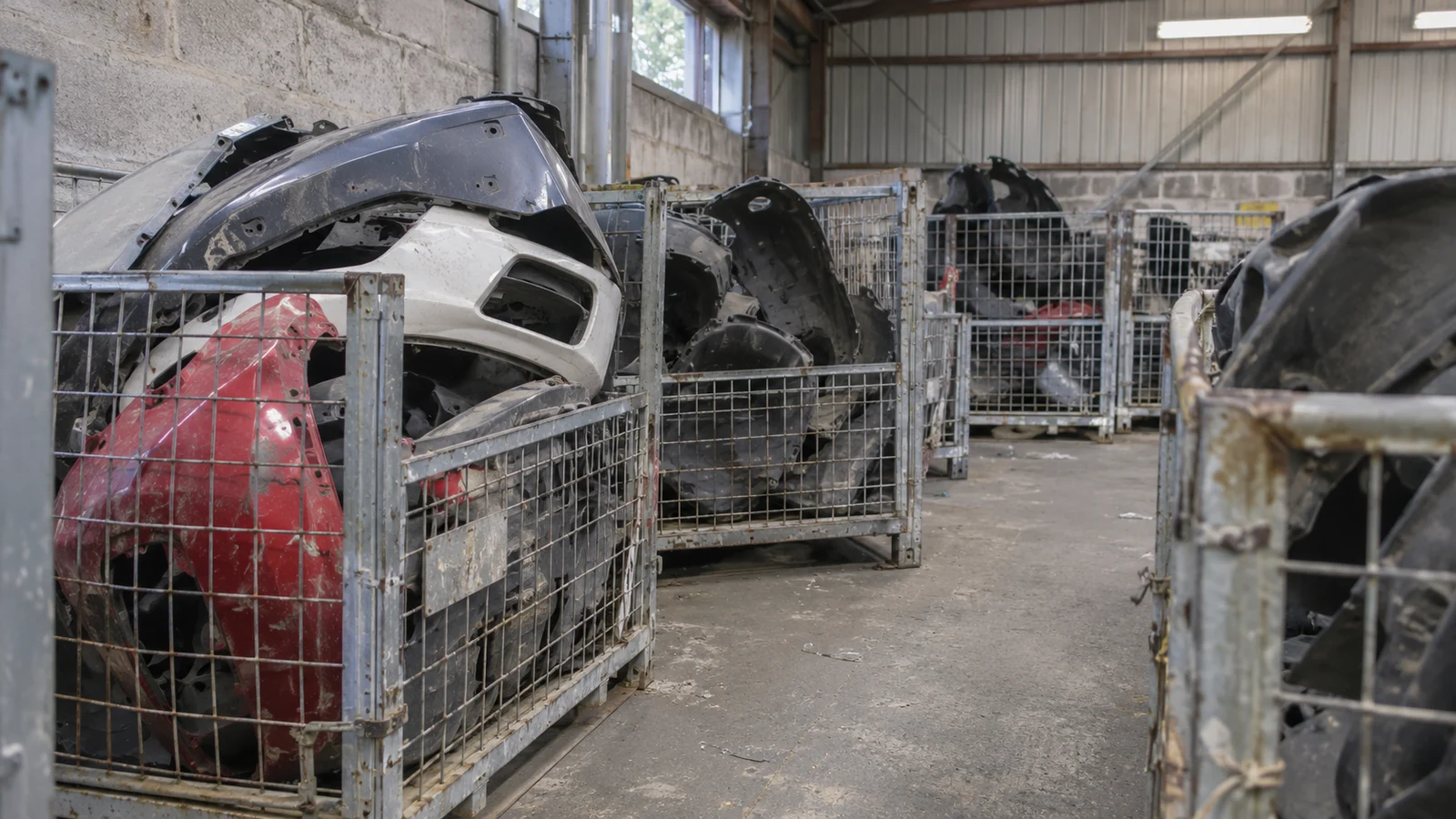
Ask where the recycled plastic in a new car ends up and the honest answer is: mostly in places nobody looks. The brochure may talk about sustainability in the seats and the dashboard, but the real volume of recycled material is doing quiet, unglamorous work underneath the paint and behind the panels. This article answers the questions garage owners and parts people actually ask about it — starting with the obvious one.
Does new-car plastic really contain recycled material?
Yes, and increasingly so. Carmakers across the board have made recycled-content commitments as part of wider sustainability programmes, and their suppliers now routinely offer compounds built on recycled polymer. The share varies widely between models and manufacturers, and visible headline figures should be treated cautiously — but the direction of travel is one way. A material that was once specified only when it saved money is now specified because the vehicle programme demands it.
Which parts are actually made from it?
The workhorses. Wheel arch liners and undertrays lead the list — large, tough, hidden mouldings where recycled polypropylene performs indistinguishably from virgin. Behind them come boot trims and load-floor panels, air ducting, battery trays, cable conduits, fan shrouds, seat substrates and the structural reinforcements hidden inside bumper assemblies. What these parts share is a brief written around function: stiffness, impact resistance, temperature tolerance. None of them has to look pretty, and that is precisely why they absorb so much recycled material.
Why does it hide out of sight?
Because the hardest thing to guarantee with recycled polymer is not strength — it's finish. A painted exterior panel must take colour identically across every car in a production run, and a visible interior moulding must match its neighbours in grain and shade. Recycled feedstock, drawn from many sources, carries small variations that engineers would rather not fight on a surface the customer stares at. So the logic runs: specify recycled grades wherever performance is the whole brief, keep virgin material where appearance is part of it. As sorting and processing improve, that boundary keeps shifting — recycled content has already crept into some visible trim — but the under-the-skin parts will carry the bulk of it for years yet.
Where does the feedstock come from?
Two broad places. Post-industrial material — offcuts, sprues and rejects from moulding plants — is the easy half: clean, known, consistent. The harder and more valuable half is post-consumer material: plastic that has lived a life on a vehicle and come back. Repair and end-of-life bumpers are the standout stream here, because they arrive in volume and in essentially one polymer. That is the loop Eco Auto Solutions works in: bumpers and trims gathered through dedicated bumper collection rounds are hand-stripped of clips, brackets and fixings, granulated into PP regrind, and supplied back into manufacturing — with nothing going to landfill. The cleaner the input stream, the higher up the car the output can go.
Can a bumper become a bumper again?
Increasingly, parts of one. The painted outer skin of a new bumper still tends to be virgin or high-virgin material for the finish reasons above, but the reinforcements, brackets, energy absorbers and liners around it are natural homes for recycled PP — often blended with virgin polymer and tuned with fillers to hit the exact specification. So the honest picture is not a tidy bumper-to-bumper circle, but something arguably better: one old bumper feeding material into many parts of many new cars.
What's holding recycled content back?
Not demand — supply. Compounders can sell every tonne of consistent, well-sorted automotive-grade recyclate they can get, and the constraint sits upstream, at the point where plastic either enters a clean single-polymer stream or gets buried in a mixed skip. Every bumper that goes to landfill, and every load contaminated with mystery polymers, shrinks the pool that new cars can draw on. Which means the workshops and bodyshops generating this material aren't bystanders to the recycled-content story; they're the start of it. If your site's bumpers and trims could be feeding that loop instead of a skip, we're on 0141 260 6602 — or send us a message.
FAQ
How much of a typical new car's plastic is recycled?
There's no single honest number: it differs by manufacturer, model and even trim level, and published figures measure different things (by weight, by part count, interior only). What can be said safely is that the share is modest today, growing steadily, and concentrated in the hidden functional parts described above.
Does recycled plastic come from old cars or from packaging?
Both routes exist, but automotive engineers generally prefer feedstock that started life as automotive material — the polymer grades, fillers and additives are already in the right family. A stream of pure PP bumpers is worth more to a car-parts moulder than mixed packaging recyclate ever will be.
Why not just use recycled plastic for everything?
Appearance-critical surfaces and a handful of safety-critical applications still demand the predictability of virgin material, and some recycled grades can't yet meet the odour and emissions standards set for cabin interiors. The sensible strategy — and the one the industry follows — is matching recycled grades to the parts where they're fully equivalent.
Does buying a car with recycled content compromise durability?
No. A part moulded from a properly specified recycled compound has to pass exactly the same validation testing as its virgin equivalent — the manufacturer's requirement doesn't soften because the material had a previous life. Where recycled grades can't meet the test, they simply don't get specified.