Bumper Collection in Middlesbrough & Teesside
Teesside built its name on taking raw materials seriously — fitting, then, that its bodyshops' waste bumpers become raw material again rather than landfill.
Our Teesside leg runs off the A1/A66 through Darlington to Middlesbrough, Stockton and the coast, collecting the full automotive plastic stream from the region's garages and accident repair centres: bumpers in any condition, wheel arch liners, trims and grilles, headlights in dedicated bins, and scrap alloy wheels — all on one scheduled visit.
Industrial-grade housekeeping
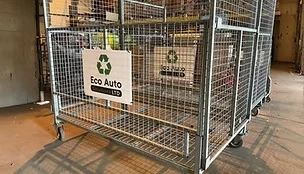
- Supplied storage — bins, cages and bumper racking sized to your throughput, from a single-unit garage to a high-volume ARC
- A schedule that repeats — weekly, fortnightly, monthly or one-off; no minimum volume
- Documentation at the van door — an electronic waste transfer note issued before the driver leaves, under registration WCR/R/3021810 (valid across Scotland, England and Wales); the Environment Agency oversees your duty of care here, and the eWTN is its paper trail
- A genuine end point — hand-stripping, then granulation into PP regrind that goes back into manufacturing; nothing to landfill
The Teesside patch
Middlesbrough, Stockton-on-Tees, Thornaby, Billingham, Redcar and the coast — with Darlington and Newton Aycliffe on the approach, and the Newcastle and Wearside routes connected to the north.
Teesside bodyshop ready to put the waste stream on a schedule? Get booked in or call 0141 260 6602.
FAQ
Which Teesside towns are on the route? Middlesbrough, Stockton, Thornaby, Billingham, Redcar, Darlington and Newton Aycliffe — the whole conurbation sits on one leg.
Can high-volume accident repair centres get weekly visits? Yes — weekly scheduling with bumper racking supplied is standard practice for high-output Teesside sites.
Do kerbed alloys and broken headlights go on the same collection? Yes — every stream travels on one van, each in its own container, covered by a single eWTN per visit.
What happens to a Middlesbrough bumper after pickup? It's hand-stripped of fixings and non-PP components, granulated into polypropylene regrind, and supplied back into plastics manufacturing.