Are Headlights Recyclable? What's Inside a Modern Light Unit
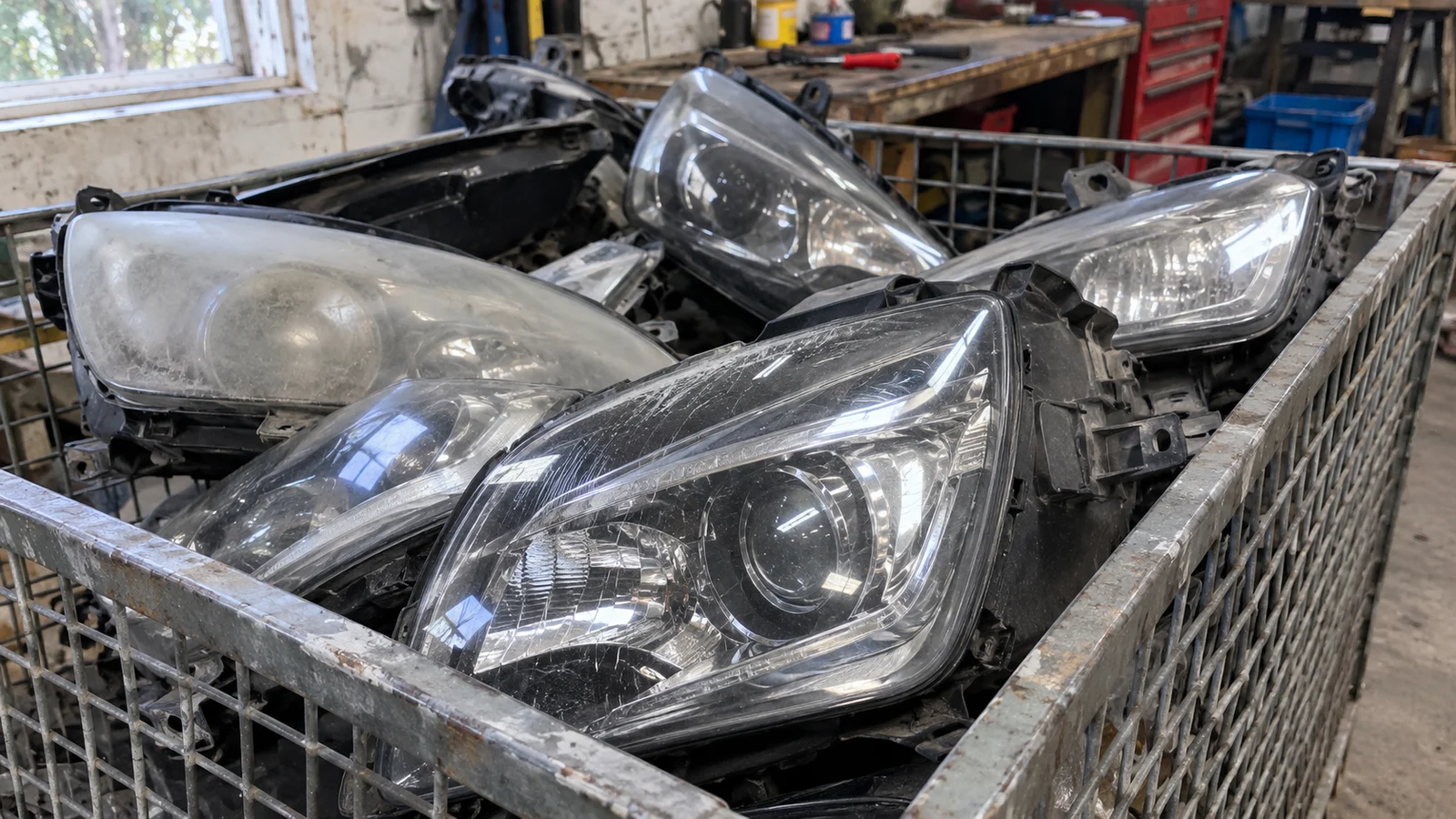
A headlight used to be a bulb behind glass. Today's unit is closer to a computer peripheral that happens to emit light: optics, electronics, heat management and styling fused into one sealed assembly that can cost more than a week's wages to replace. So when one comes off a damaged car, the question is worth asking properly — is any of that recyclable? The best way to answer is to take one apart, layer by layer, which happens to be exactly how they're recycled.
The lens: polycarbonate, not glass
Start at the front. Nearly every modern lens is polycarbonate — chosen because it's far lighter and more impact-resistant than glass and can be moulded into the swept, complex shapes designers want. Its weakness is UV light, which is why lenses leave the factory with a thin protective hardcoat and why older, weathered units turn cloudy and yellow once that coat wears through. As a material, polycarbonate is thoroughly recyclable; the catch is that it must be liberated from everything behind it first, and the degraded coating means reclaimed lens material heads into undemanding applications rather than back into optics.
Behind the lens: mirrors made of plastic
The bright silver reflectors and bezels inside look like metal but rarely are. They're mouldings — often ABS or more polycarbonate — carrying a vacuum-deposited aluminium layer thinner than paint. That metallisation is superb at its job and a nuisance for recycling: it's too thin to recover as metal yet enough to count as contamination in a plastic stream, so these parts are separated out rather than mixed with the clean polymer.
The housing: the recycler's reward
The black shell at the back is the unit's biggest single piece of plastic, and it's usually polypropylene — frequently a filled grade, stiffened with talc or glass fibre to hold the optics rigid. This is the part with the clearest second life. Stripped of clips, seals and residual sealant, housings granulate into the same family of material as bumpers, feeding the PP regrind that goes back into manufacturing.
The electronics: where new headlights get complicated
Here the generations diverge. A halogen unit hides little more than bulb holders, adjusters and a wiring loom. Xenon units add a ballast and igniter; LED units add light modules, aluminium heatsinks, driver electronics and sometimes cooling fans. None of this belongs anywhere near a granulator. Circuit boards and modules route into electronic-waste recovery, aluminium goes to metal recycling, and copper wiring is recovered separately. The more sophisticated the headlight, the more of its value sits in these components rather than in the plastic.
Holding it all together: the awkward bit
Lens and housing are bonded with sealant or adhesive around the full perimeter, and internal parts are clipped, screwed and heat-staked in place. This is why a headlight can't simply be shredded whole with any useful result — the output would be a mongrel flake of mixed polymers, metal fragments and cured adhesive that no compounder will touch. The unit has to be opened and sorted by hand, which is how Eco Auto Solutions processes every unit that comes through its headlight collection rounds: dismantled at the Hamilton facility, separated into clean material streams, with nothing sent to landfill.
So: recyclable?
Yes — properly, most of it, and the answer is getting more valuable as units get more expensive and more electronic. What a headlight is not is conveniently recyclable: every worthwhile outcome runs through dismantling, and every shortcut runs through contamination. For a workshop, that translates into one simple habit — keep dead light units as their own stream rather than letting them vanish into mixed waste, where every layer described above is lost together.
If units are accumulating on your shelves, we collect them — alongside bumpers and other plastics — across all of Scotland and the North of England, including Carlisle, Penrith, Newcastle, Middlesbrough, York, Leeds, Bradford, Manchester and Liverpool. Arrange it through our contact page or on 0141 260 6602.
FAQ
Are LED headlights harder to recycle than halogen ones?
Harder, but more worthwhile. An LED unit carries more components and more dismantling time, yet also more recoverable value — aluminium heatsinks, circuit boards, copper — alongside the same plastics. Halogen units are quicker to process but yield mostly polymer.
Does a yellowed, cloudy lens mean the plastic is ruined?
No. The cloudiness lives in the degraded surface coating and the outermost material; the polycarbonate beneath is intact. It rules the lens out of optical reuse, not out of material recycling — reclaimed lens polymer simply goes into applications where clarity doesn't matter.
Can a good headlight be reused whole instead of recycled?
Sometimes — undamaged units from written-off vehicles have a reuse market, and reuse beats recycling where it's viable. Units coming off accident repairs, though, are usually cracked, broken-tabbed or water-damaged, which is when dismantling for materials becomes the right route.
What about the bulbs themselves?
Keep them out of the plastic stream. Halogen bulbs are glass and metal; xenon bulbs contain small amounts of substances that need controlled handling; LED sources are electronics. All are removed during dismantling and routed to their own recovery streams rather than granulated.