Bumper Materials Explained: PP, ABS and Composites — and Why It Matters
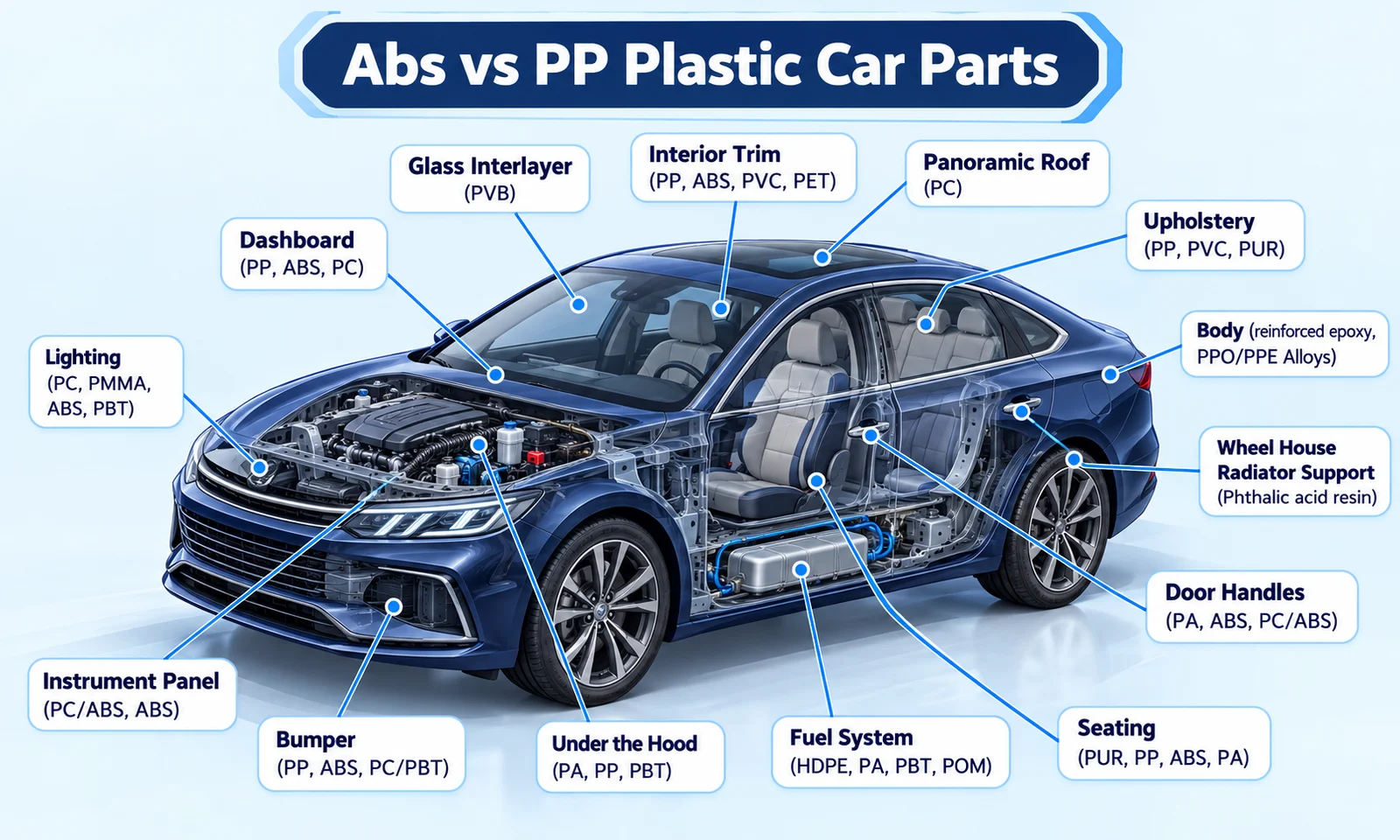
Flip a bumper over and look for the stamp. Moulded into the back of almost every modern bumper is a short code inside angle brackets — >PP/EPDM<, >ABS<, >PC/ABS< — and that little stamp answers more questions than most people realise: whether the part can be plastic-welded, how it should be prepped for paint, and what it's worth as recycling feedstock. Here's how to read it.
Step 1: Find the stamp
Manufacturers mark the polymer on the inside face of the moulding, usually near a mounting point or along a reinforcing rib. The letters between the angle brackets are the material; anything after a slash or hyphen is a blend or additive. Thirty seconds with a torch tells you what you're holding.
Step 2: Know the big three
Polypropylene (PP) — the king. The overwhelming majority of modern bumper covers are PP or a PP blend such as >PP/EPDM< (rubber-modified for flexibility). It's light, cheap, impact-tolerant and happily plastic-welded, which is why it took over the industry. For recyclers it's the prize: a clean stream of bumper PP granulates into consistent PP regrind that manufacturers genuinely want.
ABS — the older stager. Stiffer and glossier than PP, common on older vehicles, grilles, trims and some light housings. ABS is recyclable in its own stream, but it is not PP — and that difference matters more than it looks, as step 3 explains.
Composites and the rest — glass-fibre reinforced plastics (GRP), polycarbonate blends like >PC/ABS<, polyurethane (PU) on some older flexible bumpers, and carbon-fibre pieces on performance cars. These behave differently in repair — thermosets like GRP can't be melted and re-formed the way PP can — and they follow different recycling routes.
Step 3: Understand why mixing is the enemy
Melt PP and ABS together and you don't get a usable hybrid — you get contaminated material that performs as neither. Polymer purity is what separates regrind a manufacturer will buy from mixed scrap nobody wants. This is exactly why collected bumpers are hand-stripped before granulation: brackets, absorbers, sensors and any non-PP mouldings come off first, so the granulator sees one polymer, not a cocktail.
It's also why workshop segregation pays. Bumpers and large PP mouldings kept as their own stream — rather than tipped in with mixed plastic waste of every flavour — arrive cleaner and recycle better.
Step 4: Let the material guide the repair decision
The stamp helps with the repair-or-replace call too. A cracked PP cover is a strong welding candidate: the material fuses well and takes paint happily afterwards. ABS can be bonded and repaired with the right consumables. A shattered GRP or carbon piece is a different conversation entirely. None of this replaces a repairer's judgement — but the judgement starts with knowing the material.
Step 5: Give every outcome a route
However the repair call goes, the plastic has somewhere useful to end up. Covers too far gone are granulated; good PP cores feed manufacturing as regrind; and the few bumpers that come off vehicles in genuinely sound condition skip the granulator for refurbishment and resale. The stamp on the back is where that whole chain starts.
Workshops across all of Scotland and the North of England can put their bumper stream on a schedule with one call — 0141 260 6602, or drop us a line via the contact page.
FAQ
What does >PP/EPDM< on the back of a bumper mean? Polypropylene blended with EPDM rubber — the most common bumper material on modern cars. The rubber content adds flexibility so the cover absorbs knocks without cracking.
Can ABS and PP be recycled together? No. They're incompatible polymers: melted together they produce weak, unusable material. Each needs its own stream, which is why material identification and hand-stripping matter so much.
Are carbon-fibre or GRP bumpers recyclable? Not by melting and granulation — they're thermoset composites, so they can't be re-formed the way PP can. They follow separate, more limited recovery routes, which is one reason mainstream cars stick with thermoplastics.
Why are nearly all modern bumpers polypropylene? It hits the sweet spot: light, inexpensive, impact-resistant, paintable, weldable for repair — and recyclable back into high-quality raw material at end of life.