Choosing an Automotive Waste Management Partner: What Good Looks Like
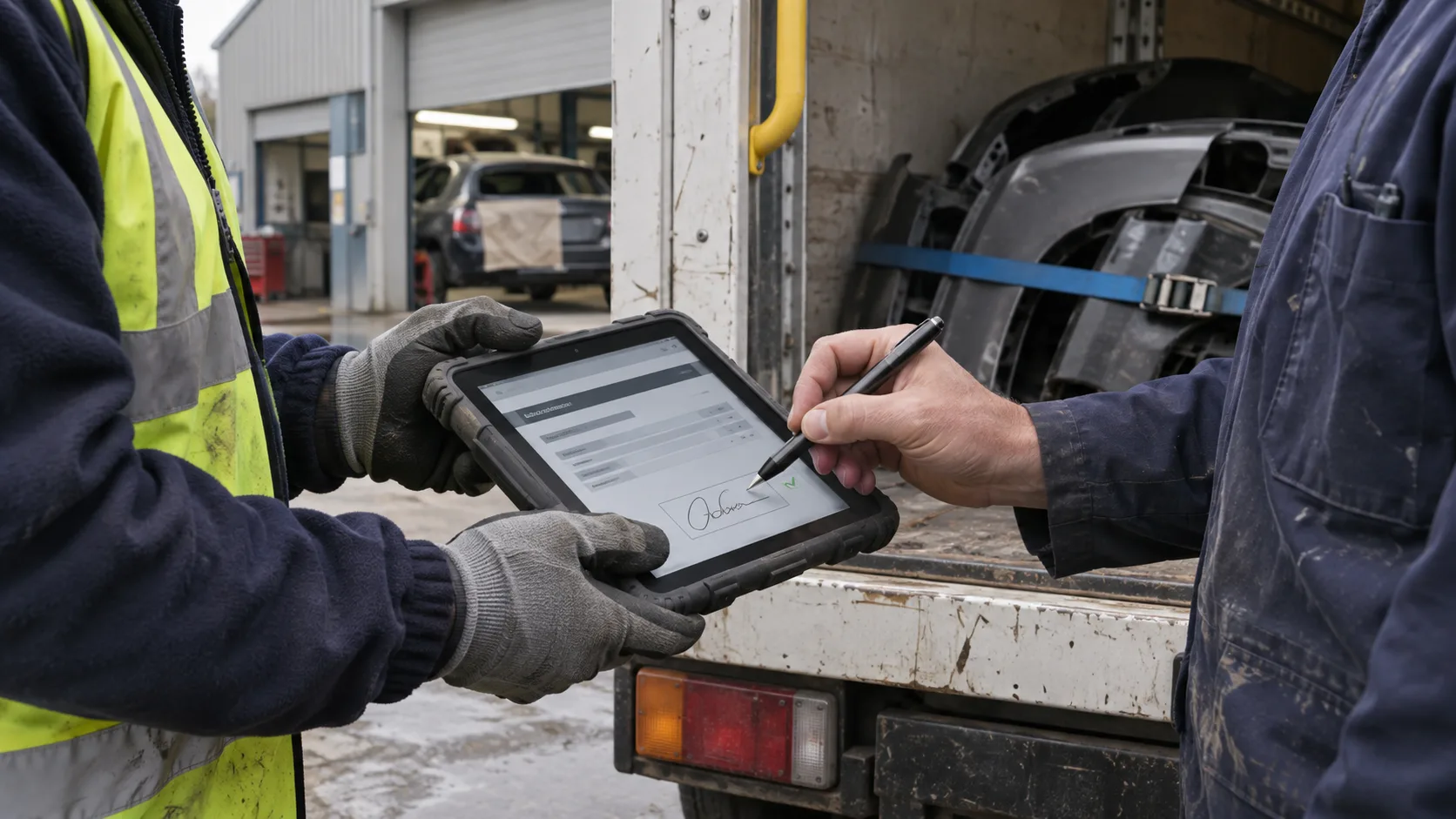
Few workshops ever truly chose their waste contractor. The arrangement came with the building, or started years ago with whoever answered the phone first, and has rolled on ever since because changing it never made it to the top of anyone's list. That inertia matters more than it used to: under the duty of care that applies to every business producing waste in Scotland, England and Wales, your contractor's conduct is bound up with your own compliance. Choosing one deserves the same scrutiny as choosing a paint supplier — so here is a framework for judging the difference between a partner and a liability.
Six dimensions, side by side
| Dimension | What good looks like | Warning sign |
|---|---|---|
| Authorisation | Registered with the regulator, findable on the public register before you sign anything | "We're fully licensed" with nothing you can check |
| Paperwork | A transfer note produced at every collection, without being asked | Documentation that arrives late, sporadically, or only on request |
| Destination | Can tell you plainly what becomes of your material after the van leaves | Vague about where loads go, or evasive when asked |
| Equipment | Supplies containers suited to the material and your space | Expects you to improvise storage, or sells you kit you didn't need |
| Scheduling | A frequency chosen around your throughput, adjustable as it changes | A fixed round you must fit yourself into, full bins or empty |
| Scope | Handles the streams your workshop actually produces | Takes the easy material and leaves you juggling the rest |
The table is the shortlist test. Three of those rows deserve a closer look, because they're where good and bad partners diverge most sharply in practice.
Authorisation: check before, not after
Everything else a contractor promises rests on this row, and it is the only one you can verify entirely from your desk. Scotland's register is held by SEPA, England's by the Environment Agency, and both are public precisely so producers can look before they hand anything over. Here's how to verify a waste carrier on the SEPA register in a few minutes; a candidate who hesitates when you ask for their registration number has answered a different question. Ours is WCR/R/3021810, valid across Scotland, England and Wales, and we'd rather you checked it than took the sentence on trust.
Destination: the question too few producers ask
Most selection conversations stop at the kerbside — who collects, how often, what it costs. The better question is what happens next, because the answer separates genuine recovery from a longer road to the same hole in the ground. For automotive plastics there is a specific, checkable answer available: through our plastic waste collection, bumpers, wheel arch liners, side skirts, trims and grilles are hand-stripped, granulated into PP regrind and supplied back into manufacturing, with nothing going to landfill. Whoever you appoint, insist on an answer of that shape — a destination you could repeat to a customer or an auditor without flinching.
Equipment and scheduling: the partnership rows
The last two rows are where "supplier" becomes "partner". A contractor who turns up with the right containers — in our case, bins, cages and bumper racking supplied to collection clients — has thought about your yard, not just their round. And a schedule should be a conversation, not a timetable you inherit: weekly, fortnightly, monthly or one-off collections, with no minimum volume, means a two-bay smart repairer and a multi-site group can both be served properly rather than one being forced into the other's pattern.
Run the test on us
We're content to be scored against our own table — that's rather the point of publishing it. We collect across all of Scotland and the North of England, so if your current arrangement fails a row or two, put the six questions to us or call 0141 260 6602.
FAQ
Should the cheapest quote win?
Only if it survives the other five rows. A low price from a contractor with shaky authorisation or missing paperwork isn't a saving — it's a transferred risk, because the duty of care stays with you as the producer. Compare total exposure, not just the line on the invoice.
Is one partner for everything better than a specialist for each stream?
Fewer vans and fewer contracts simplify life, but only where each stream is still handled well — consolidation is a means, not a goal. A sound middle course is one specialist per family of material: one route for plastics and associated streams, rather than either a contractor-per-item sprawl or a single generalist doing everything adequately and nothing well.
How do we switch contractors without a gap in collections?
Overlap, don't handover. Confirm the new partner's registration and first collection date before giving notice on the old arrangement, and keep the final transfer notes from the outgoing contractor filed with the rest. A short period of double cover costs little; a fortnight with no collection route shows up in your yard immediately.
What should a review of an existing partner cover, and how often?
Annually is a sensible rhythm: re-check the registration on the public register, confirm the paperwork file is complete for the year, revisit whether the collection frequency still matches your throughput, and ask again where the material ends up. A partner whose answers improve year on year is worth keeping; one whose answers shrink is telling you something.