One Van, Every Stream: Why Consolidating Your Waste Contractors Pays Off
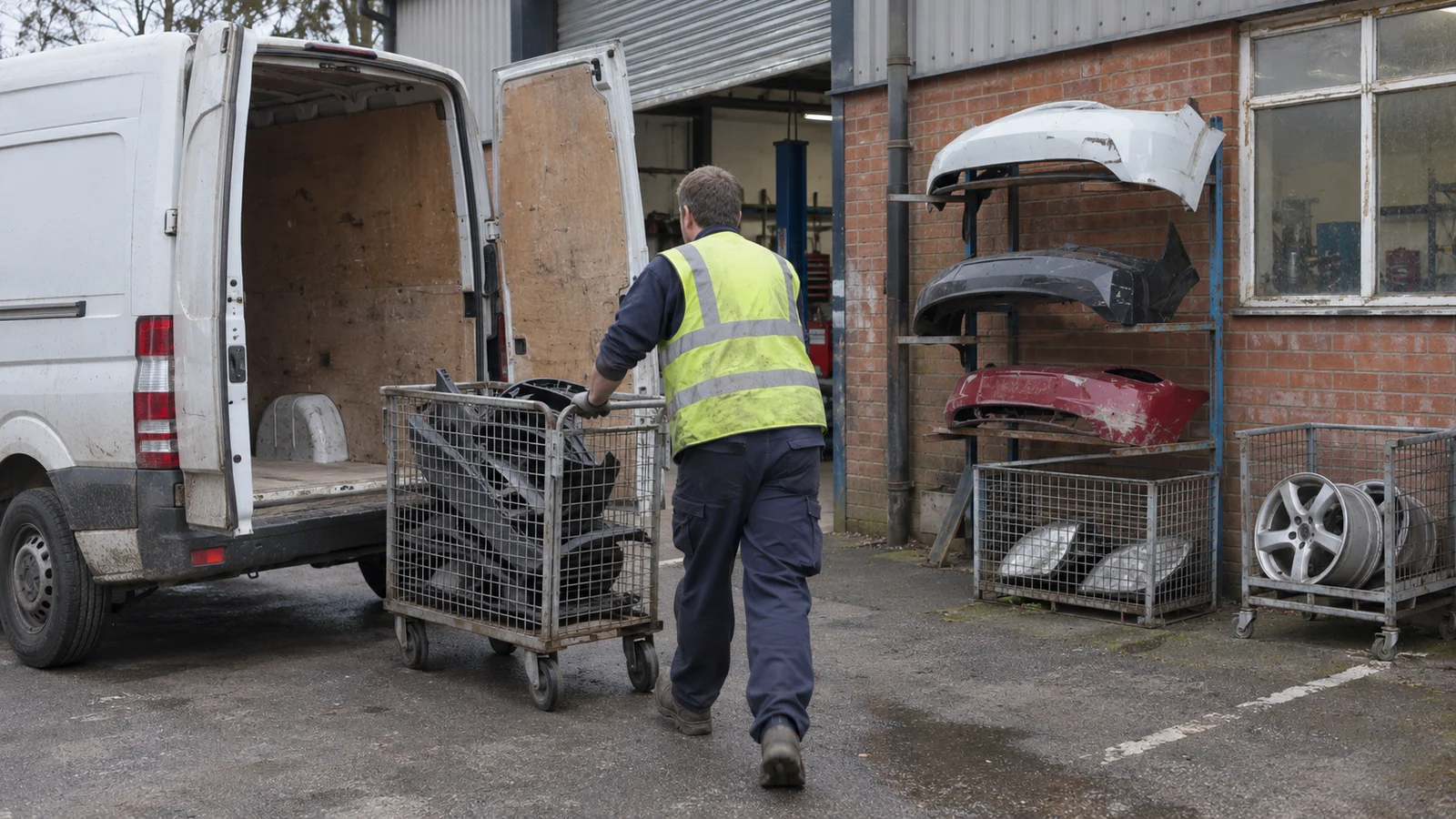
Bumpers with one firm. Scrap alloys with a metal merchant who turns up when he's passing. Headlights in a corner because nobody's sure whose job they are. Trims and liners in the general waste, quietly inflating the bill. Most workshops never chose this arrangement — it accumulated, one contractor at a time, each solving one problem on the day it became urgent. The result is a supplier list that works, roughly, but costs more attention than anyone realises. Consolidating those streams onto one vehicle is one of the few operational changes that simplifies a workshop rather than adding to it.
The overhead nobody prices
Every additional waste contractor brings a shadow workload: another account to open, another registration to verify on SEPA's or the Environment Agency's register, another invoice to process, another phone number to chase when a pile is overflowing, another set of transfer notes to keep for the two-year standard. None of these items is big. Multiplied across four or five relationships, they become a standing tax on whoever runs the workshop — usually the same person who is supposed to be running jobs through the shop.
Four contractors vs one partner
| Multiple contractors | One consolidated partner | |
|---|---|---|
| Collection visits | Several vehicles, several days, each interrupting the yard | One scheduled visit covering every stream |
| Paperwork | Separate transfer notes in separate formats, some still paper | One eWTN trail, issued at every collection before the driver leaves |
| Registrations to verify | One per contractor, each needing periodic re-checking | One, checked once on the public register |
| Storage | Whatever containers each firm does or doesn't provide | Bins, cages and bumper racking supplied, matched to the streams |
| When volumes spike | Ring around and hope someone can fit you in | One call to flex one schedule |
| When something's missed | Establish whose stream it was before anyone will collect it | No ambiguity about whose job it is |
The table understates one thing: the compounding effect. A missed collection from one of five contractors doesn't just delay that stream — it triggers the ring-around, the blocked bay, the "just skip it this once" decision that undermines the segregation everyone worked to set up.
What consolidation looks like in practice
Eco Auto Solutions built its collection service around exactly this problem. One vehicle takes bumpers, headlights, hard and soft plastics — wheel arch liners, side skirts, trims, grilles — and alloy wheels in the same visit, on a weekly, fortnightly, monthly or one-off schedule, with no minimum volume to qualify. The plastic waste collection and alloy wheel collection run as segregated streams on the same round, and collection clients get the bins, cages and bumper racking to keep those streams clean between visits. An eWTN is issued at every collection before the driver leaves, so the compliance file for all of it builds in one format, from one source.
There's a bonus stream most workshops don't expect: unused genuine OEM parts. Redundant stock photographed and sent in gets an offer within 24 hours, and anything agreed is simply collected with the next scheduled pickup — turning the same van visit into money coming in as well as waste going out.
What you shouldn't consolidate
Honesty matters here: not everything belongs on one vehicle. Hazardous streams — waste paint and thinners, contaminated rags, batteries, used oils and filters — need carriers and treatment routes built for hazardous material, and no plastics specialist should be offering to sweep those onto the same round. The realistic end state for a workshop is two or three well-chosen relationships — a hazardous-waste specialist, general waste, and one partner for the recyclable automotive streams — instead of six or seven accidental ones. Consolidation is about removing the redundant relationships, not forcing incompatible waste together.
Fewer vans, fewer gaps
Every contractor on the list is a relationship to manage and a gap something can fall through. Shrinking the list shrinks both. Eco Auto Solutions covers all of Scotland and the North of England — including Carlisle, Penrith, Newcastle, Middlesbrough, York, Leeds, Bradford, Manchester and Liverpool. To see how many of your current streams one van could take, tell us what's in your yard via our contact page or call 0141 260 6602.
FAQ
If everything goes on one vehicle, doesn't it all get mixed together?
No — consolidation is about one visit, not one pile. Streams stay segregated in their own bins, cages and racking on site and travel as separate streams, which is what keeps the plastics clean enough to granulate into manufacturing-grade material.
One of our streams builds up much faster than the others. Does that break the model?
It's the normal case, not the exception. The schedule is set around your fastest-filling stream — usually bumpers in a busy bodyshop — and the slower streams simply ride along on the same visit, whether there's a cage-full or a handful.
We already have a scrap metal merchant for alloys. Is it worth moving them?
That depends on what the arrangement really costs you. If the merchant collects reliably, documents every load and the price is right, keep it. If alloys sit for weeks waiting for someone to be "passing", moving them onto a scheduled round with your plastics removes a contractor, a delay and a pile in one decision.
How do we switch without a gap in collections?
Run the old and new arrangements in parallel for one cycle: book the first consolidated collection, let it prove itself on a live load, then wind down the contractors it replaces. Because there's no minimum volume, the first visit can happen while your existing piles are still small — no need to stockpile for a grand handover.