Does Paint Stop a Bumper Being Recycled?
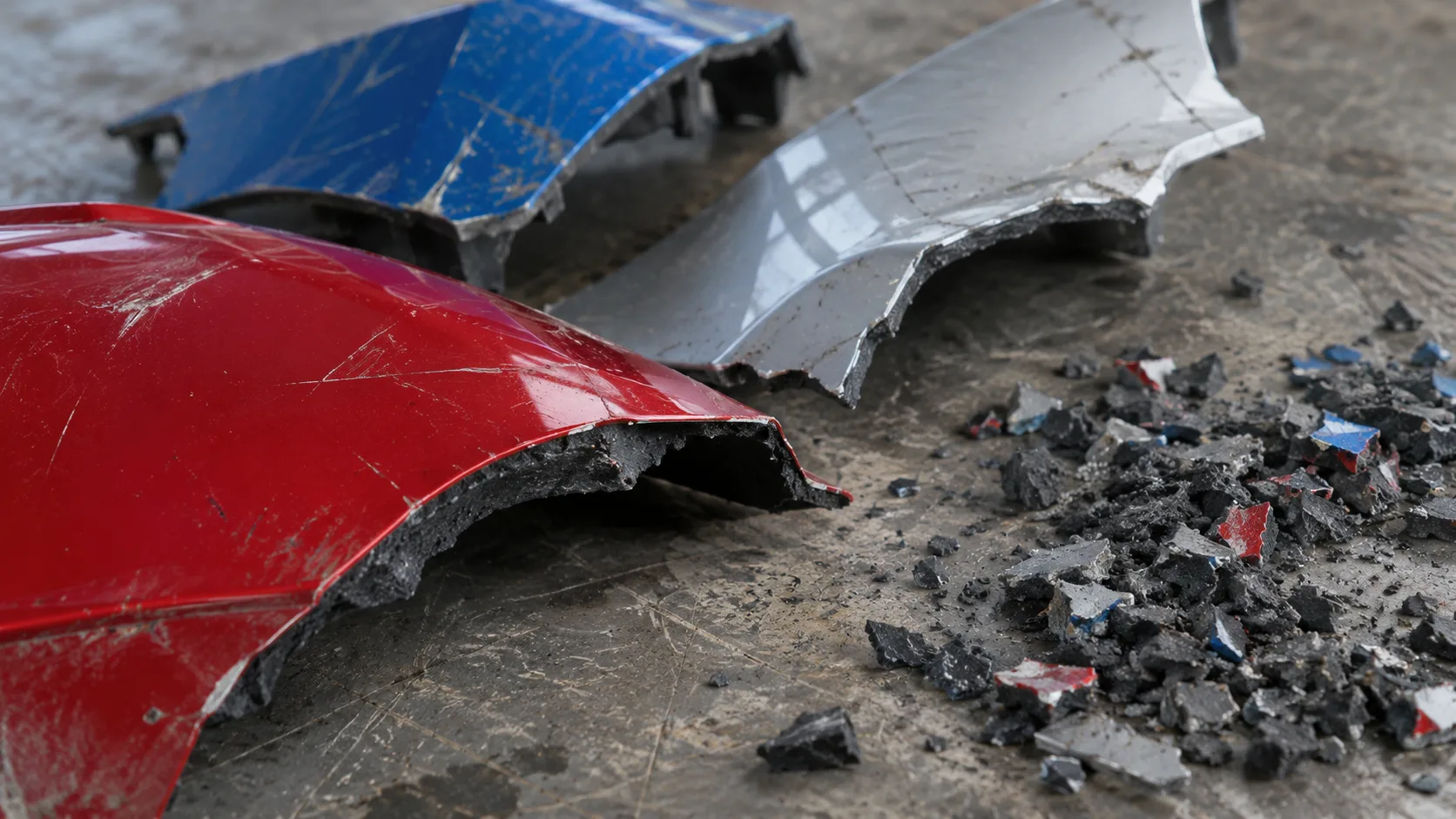
Short answer: no. Longer answer: paint is the single most interesting complication in automotive plastics recycling, and the way the industry handles it says a lot about how recycling really works. This piece takes the questions in the order people ask them.
Why are bumpers painted in the first place?
Because polypropylene, left to itself, is not a showroom material. Paint delivers the colour match with the steel panels around it, gloss, stone-chip resistance and protection from ultraviolet light, which ages unprotected polymers. A factory finish is a layered system — an adhesion promoter so paint will grip a low-energy plastic at all, then primer, colour and clearcoat, formulated flexibly enough to bend with the panel. It is engineered to stay attached through a decade of weather and jet-washing. Which is precisely the problem at end of life: a coating built never to let go doesn't politely step aside for the recycler.
What does paint actually do to recycled plastic?
Paint is not polypropylene, and it doesn't behave like it. Granulate a painted bumper and the coating comes along as flakes and fine particles scattered through the regrind. When that material is melted and remoulded, paint fragments don't melt with it — they persist as specks that show in the surface and as inclusions that can weaken the finished part, in the way a pebble weakens concrete. By weight the coating is a small fraction of the bumper; by consequence it can be the difference between regrind a manufacturer accepts and regrind they send back. The quality of recycled plastic is largely a story about what isn't in it.
So how does the industry deal with it?
Several ways, used in combination. The first is separation before granulation: stripping each bumper of everything that isn't the base polymer — brackets, foams, fixings and trim — so the stream entering the granulator is as clean as handling can make it. That hands-on stage is how we run our own process: collected bumpers are hand-stripped, then granulated into PP regrind supplied back to manufacturing, with nothing going to landfill. Beyond that, the wider industry uses mechanical and washing stages that detach brittle paint flakes from tougher polymer granules so they can be drawn off, and careful grading, so material is matched to applications that tolerate its history. What reaches a compounder is a known quantity, not a hopeful one.
What about chrome-effect, carbon-look and textured finishes?
The same logic, different difficulty. Textured, unpainted black trim — arch liners, lower cladding, many grilles — is the easy end: the colour runs through the plastic itself, so there's no coating to fight, which is one reason mixed trim does well in a plastic waste collection. Chrome-effect parts sit at the hard end, since metallised layers are a more stubborn passenger than paint. Film-wrapped panels land in between: a wrap is designed to peel, which is more than can be said for a factory basecoat. None of these finishes makes a part unrecyclable; they change how much work stands between the part and good regrind.
Given all that, is a painted bumper still worth recycling?
Emphatically. Underneath the coating is a large, consistent moulding of one of the most reusable polymers in the industry — the same material arriving by the thousand through every bumper collection round, in volumes that justify doing the separation properly. The alternative is burying or burning a polymer that manufacturing is actively asking for. Paint makes the job harder; scarcity of good PP is what makes the job worth doing.
If painted skins, trims and liners are accumulating at your site, we collect across all of Scotland and the North of England — arrange a collection or call 0141 260 6602.
FAQ
Do we need to strip or sand bumpers before they're collected?
No. Send them painted, trimmed and as they came off the car — separation is the recycler's stage of the process, not the workshop's. The only preparation that helps is keeping bumpers and plastics in their own cage rather than mixed through general waste.
Why is some black plastic trim never painted at all?
Because the pigment is mixed through the polymer before moulding — known as mass colouring — and the moulded texture provides the finish. It's cheaper for the carmaker, hides scuffs in service, and at end of life it is the simplest automotive plastic to recycle, since there is no coating layer to deal with.
Can regrind with traces of paint still be used for anything?
Yes — fitness depends on the application. A structural or hidden component tolerates far more history than a visible, glossy one, and compounders blend and specify accordingly. That grading is why honest description of regrind matters as much as the granulating itself.
Is recycled bumper plastic ever painted again in its next life?
It can be. Properly prepared PP regrind goes into new mouldings, and a moulding is painted or left textured according to what it's for — the material doesn't remember its previous finish. The cycle of strip, granulate, remould and refinish is exactly what keeping a polymer in circulation looks like.