What Fleet Operators and Dealer Groups Need From an Automotive Waste Partner
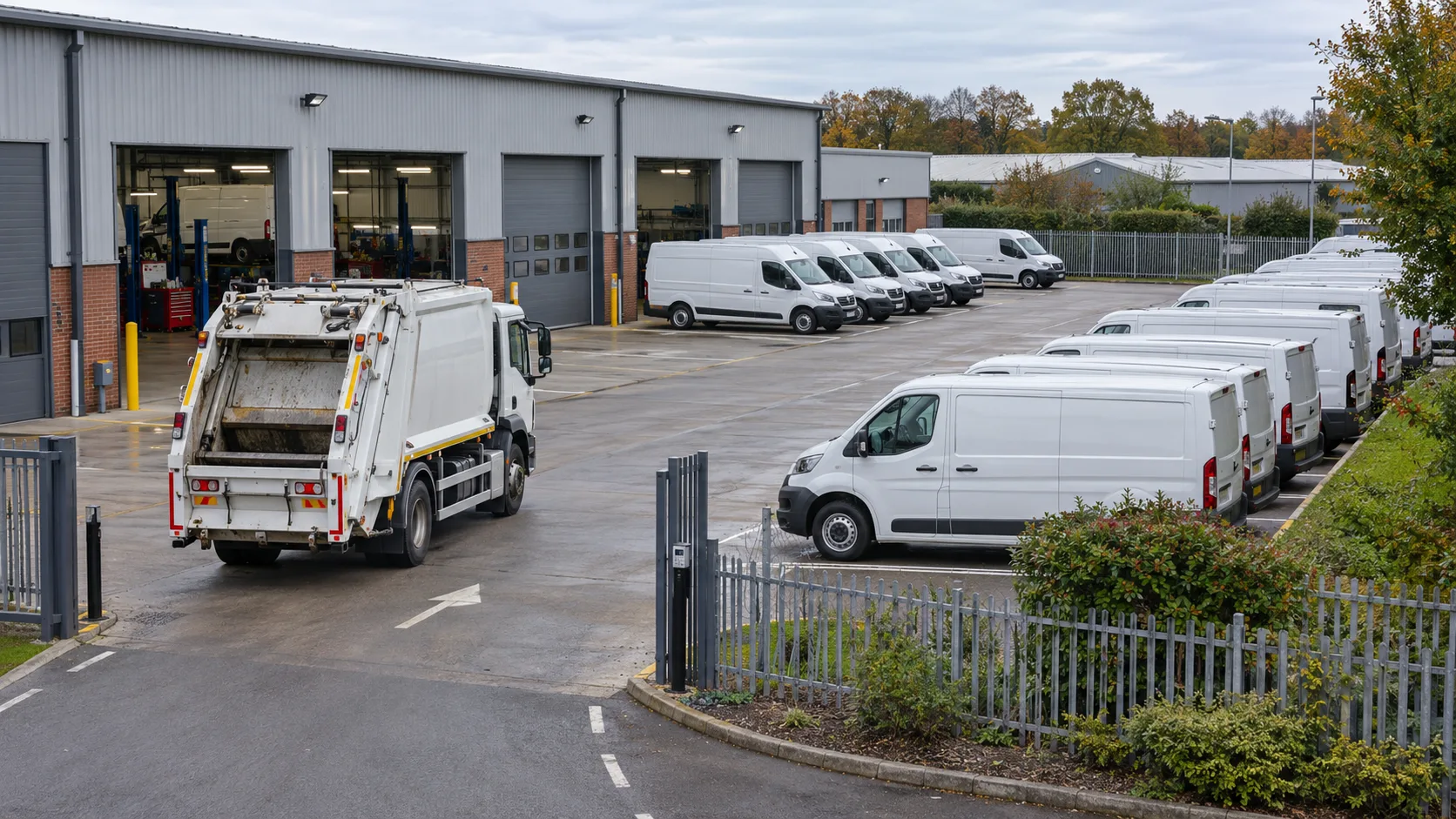
A single workshop buys a waste collection. A fleet operator or dealer group buys a system — and the difference is the whole subject of this article. Arrangements that work perfectly well for one site start to creak the moment there are six of them, because every informal understanding, local supplier and filing quirk gets multiplied by the number of locations. What a group needs from an automotive waste partner isn't a bigger version of the single-site service; it's a different shape of service altogether.
The multiplication problem
At one site, the duty of care under section 34 of the Environmental Protection Act 1990 is one manager's job: one contractor to vet, one set of transfer notes to keep, one regulator to think about. Across a group, every weakness repeats. One site using an unverified carrier is a group-level compliance exposure. One site with patchy paperwork fails the group's audit, not just its own. And a group straddling the border answers to two regulators — SEPA in Scotland, the Environment Agency in England — so "our local firm sorts it" has to be true in two jurisdictions at once.
Single site vs group: what changes
| Requirement | Works at one site | What a group needs |
|---|---|---|
| Carrier legitimacy | Someone once saw a certificate | One registration, checked centrally — knowing how to verify a waste carrier on the public register — valid everywhere the group operates |
| Geography | A contractor who covers the postcode | One partner covering every site, so the service doesn't change character at the border or the regional boundary |
| Paperwork | A transfer note in a drawer | The same document, issued the same way, at every site, every time — so a central audit file assembles itself |
| Waste streams | Bumpers in a corner, the rest ad hoc | Every stream — bumpers, headlights, hard and soft plastics, alloy wheels — through one arrangement |
| Storage | Whatever containers accumulated | Standard equipment supplied to each site, so segregation looks identical in Aberdeen and Leeds |
| Scale | Enough capacity for one yard | Headroom for the whole group's output on its busiest week |
What the right partner looks like in practice
Measured against that table, here's what Eco Auto Solutions brings to multi-site operators. One registration covers the lot: we're a SEPA-registered waste carrier (WCR/R/3021810), valid across Scotland, England and Wales and verifiable on SEPA's public register — one check your compliance team does once, for every site. Coverage is genuinely group-shaped: all of Scotland and the North of England, including Carlisle, Penrith, Newcastle, Middlesbrough, York, Leeds, Bradford, Manchester and Liverpool, from one operation rather than a patchwork of subcontractors.
Consistency is built into the paperwork — an eWTN issued at every collection, at every site, before the driver leaves — and into the yards, because we supply bins, cages and bumper racking to collection clients, so a group can standardise how material is stored rather than inheriting ten local habits. The streams consolidate too: a full plastic waste collection takes the liners, trims, skirts and grilles alongside the bumpers, with an alloy wheel collection running on the same visit. And the scale is there: a facility granulating 3,000+ bumpers a day into PP regrind doesn't need a group to ration what it sends.
The dealer-group extra: the parts shelf
Dealer groups carry a second kind of surplus that fleets largely don't — parts departments full of unused genuine OEM stock from supersessions and cancelled orders. The right waste partner turns that from a write-off line into a revenue line: we buy redundant stock from garages and dealers, collecting it with the same visit that takes the plastics, so the group's recovery story covers the parts shelf as well as the yard.
One partner, one standard
The test for a group is simple: could head office describe, in one sentence, how waste is handled at every site — and prove it? With one partner, one registration, one document standard and one set of equipment, the answer is yes. Run sites from Aberdeen to Liverpool? Put your site list in front of us and we'll map it onto one schedule — 0141 260 6602, or tell us about your group.
FAQ
Do all our sites have to come on board at once?
No. Groups commonly start with the highest-volume bodyshops or a single region, prove the service, then roll the remaining sites in — each simply joins the collection rhythm that suits its output. There's no minimum volume, so smaller satellite sites aren't excluded from the same arrangement the flagship sites use.
We have sites in both Scotland and England — does that complicate the paperwork?
It complicates whose rules apply, not what you receive. SEPA regulates your Scottish sites and the Environment Agency your English ones, but the duty of care framework is common across Great Britain and our registration is valid across Scotland, England and Wales — so the documentation each site holds looks the same on either side of the border.
How does head office get visibility of what each site is doing?
Through the documents themselves. Because every collection at every site generates its own eWTN, the group's audit trail is the sum of identical records rather than a mix of formats — which makes central collation a filing exercise, not a reconciliation project.
Our sites produce very different volumes — can one arrangement really fit all of them?
Yes, because the arrangement flexes per site rather than per group. A high-throughput accident repair centre might sit on a weekly visit while a small used-car site takes a monthly one; both sit under the same registration, documentation and equipment standard, which is the part a group actually needs to be uniform.