Green Credentials: How to Answer Customers Who Ask About Sustainability
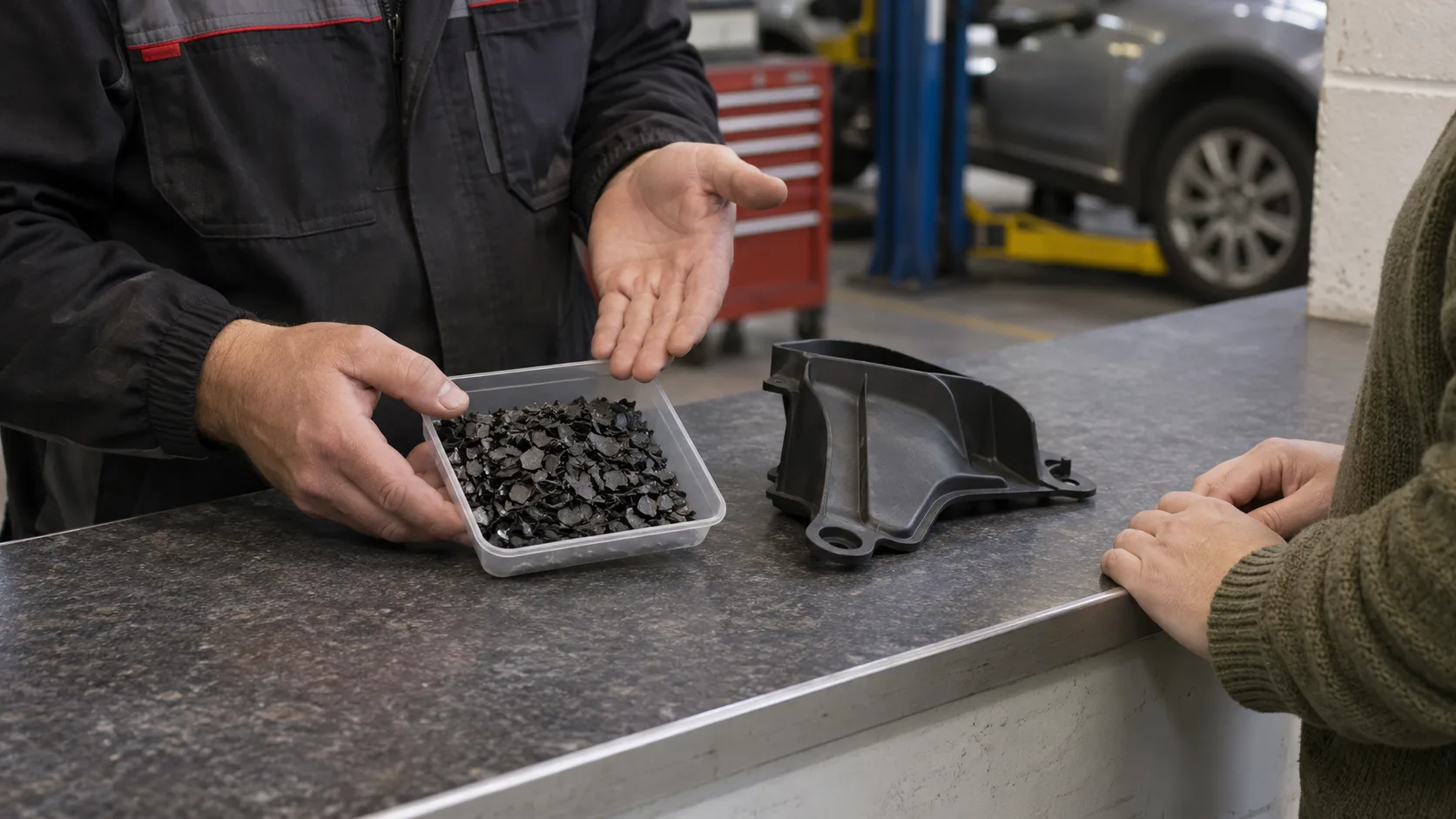
"So where does the old one go?" Sooner or later somebody asks it across the counter — a customer watching their cracked bumper come off, a fleet buyer with a questionnaire, an insurer's engineer with a tick-box about environmental practice. The question is only getting more common, and the garages that handle it well aren't the ones with the glossiest answer. They're the ones whose answer is true, specific and checkable. Here are five weak answers heard around the trade — and the stronger one to give instead.
Weak answer #1: "We're an eco-friendly garage"
Adjectives convince nobody. "Eco-friendly", "sustainable" and "environmentally conscious" are claims about mood, not practice, and the people asking the question have heard them everywhere.
Say instead: name your streams and their destinations. "Replaced bumpers and plastic trims go to a plastics recycler; wheels go for metal recovery; oils and filters go on hazardous-waste paperwork." One concrete sentence about what actually leaves your yard, and where it goes, outweighs a page of adjectives — and it's a sentence most workshops could already say if they stopped to assemble it.
Weak answer #2: "Our waste contractor deals with all that"
Outsourcing the work is fine; outsourcing the knowledge isn't. If you can't say what happens to your material after the van leaves, your sustainability story ends at your gate — and so does the customer's confidence.
Say instead: know your chain one link deeper. Who carries your waste, and are they on the public register — it takes minutes to verify a waste carrier and then you can say so. And what becomes of the material? Ours is a chain short enough to recite: collected plastics are hand-stripped, granulated into PP regrind and supplied back to manufacturing, with nothing to landfill. A workshop using a route like that can tell a customer the fate of their old bumper in one breath.
Weak answer #3: "We recycle everything" — while the skip says otherwise
The yard testifies. A customer who hears "we recycle everything" and then walks past one overflowing general-waste skip with bumpers poking out of it has learned which statement to believe.
Say instead: let the claim match the containers. Segregation you can point at — plastics in their own cages, wheels stacked separately, nothing automotive drowning in the general skip — is the most persuasive sustainability statement a workshop can make, because it's the one that can't be faked on a website. A dedicated plastic waste collection for the liners, skirts, trims and grilles is what makes that segregation sustainable in the other sense: it keeps happening because someone reliably takes the material away.
Weak answer #4: "We're 100% green"
Absolute claims are where honest businesses get into trouble. "Zero waste", "fully carbon neutral", "100% recycled" — each invites one awkward follow-up question, and regulators on both sides of the border increasingly expect environmental claims to be accurate and evidenced, not aspirational.
Say instead: claim exactly what you can show. "Our automotive plastics go for recycling, and we hold the transfer note from every collection" is modest, provable and more impressive than it sounds — an eWTN issued at every pickup means the evidence file builds itself. We'd rather every client made a smaller claim they can document than a grand one they can't; our own registration (SEPA waste carrier WCR/R/3021810) sits on the public register precisely so people can check it rather than take our word.
Weak answer #5: treating the question as marketing
The last mistake is answering well and changing nothing — sustainability as a paragraph on the website rather than a practice in the building.
Say instead: point at the parts of it that pay. Good-condition bumpers can be refurbished and resold rather than ground down. Unused genuine OEM stock sitting on the parts shelf can be sold on as redundant stock instead of being written off — reuse that shows up as revenue, not cost. When the honest answer to the sustainability question also improves the month's numbers, it stops being a question you brace for.
Build the answer once, use it forever
Put the five fixes together and you have a short, durable script: these are our streams, this is who carries them, here's where the material ends up, here's the paperwork, and here's what we reuse. If assembling that answer for your workshop would be easier with one partner behind it, we're ready when you are — across all of Scotland and the North of England. Ring 0141 260 6602 or tell us where you're starting from.
FAQ
Do customers really choose a bodyshop on sustainability?
Some do directly; more use it as a tiebreaker or a trust signal — a workshop that can answer the question crisply reads as well-run generally. Fleet and trade customers are the sharper driver: many now ask about waste practice in supplier questionnaires, where "no answer" scores the same as a bad one.
What's the difference between a fair environmental claim and greenwashing?
A fair claim is specific, true of your actual practice and supportable with evidence if challenged; greenwashing is the gap between the words and the operation — vague terms, absolute percentages nobody measured, or imagery doing the work the facts can't. The test is simple: could you show a sceptical customer the thing you just claimed?
Should we publish our recycling figures?
Only figures you actually track and can stand behind. A verifiable statement without numbers — which streams you segregate, who collects them, what the material becomes — beats an impressive-sounding tonnage you'd struggle to reconstruct. If you do publish numbers, keep the records that produced them.
How should we answer when an insurer or work provider audits us on sustainability?
With documents rather than descriptions: your carrier's registration details, transfer notes from recent collections, and a one-page summary of each stream's route. Auditors are rarely looking for perfection — they're looking for a process that exists, repeats and leaves a paper trail.