Headlight Disposal: Why Mixed-Material Light Units Need a Specialist Route
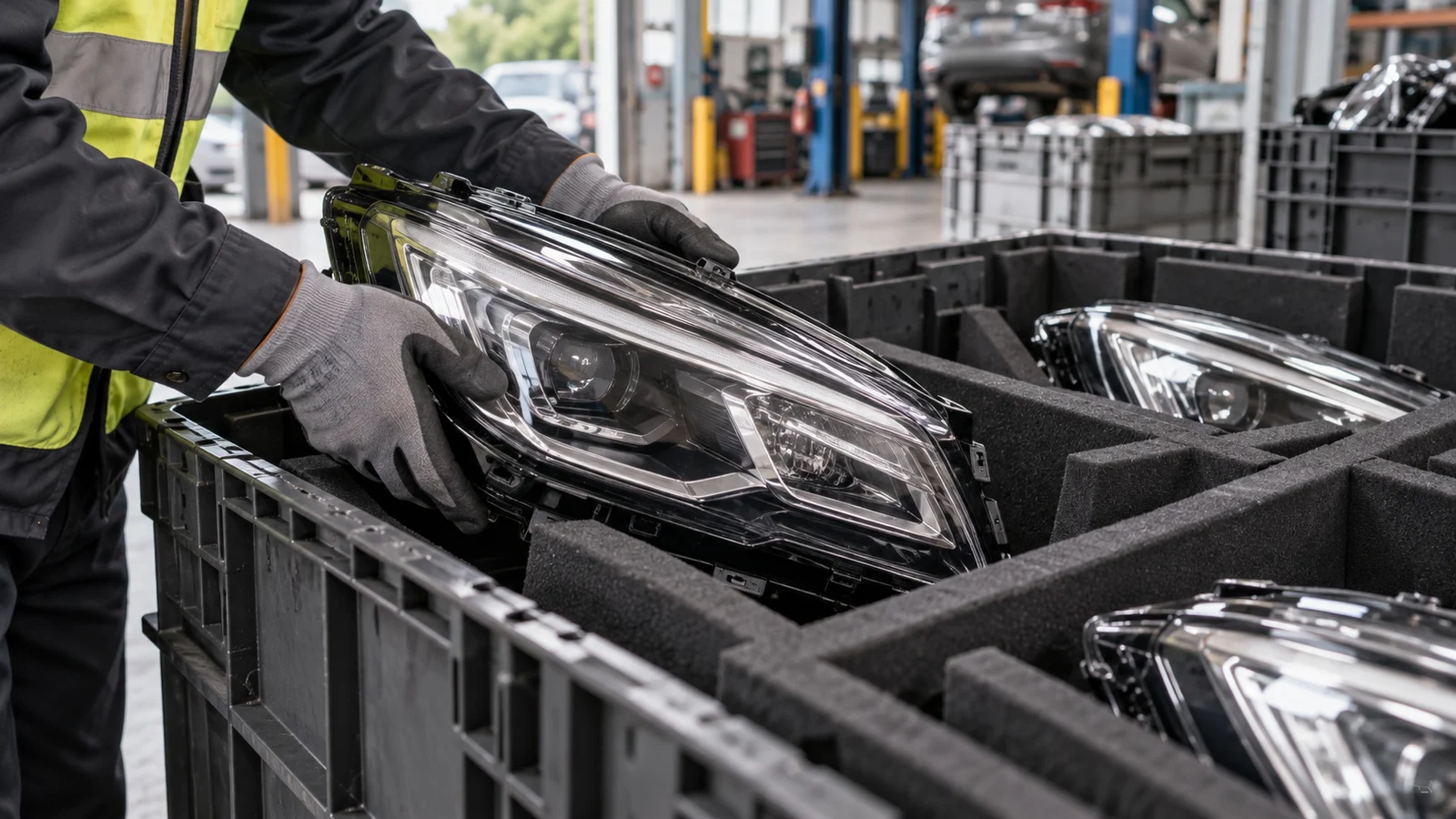
Ask a bodyshop what their most awkward waste stream is and headlights come up again and again. They're bulky, they're fragile, they don't stack, and — unlike a bumper, which is mostly one plastic — a single light unit is a sandwich of different materials bonded, clipped and screwed together. That mix is precisely why headlights deserve their own disposal route rather than a place in the general waste skip.
One unit, many materials
A modern headlight isn't one thing. The housing is typically plastic, the lens a different plastic, and inside sit metal brackets and clips, adjusters, wiring, connectors and bulb holders. Sealed as one assembly, those materials can't simply be granulated together: feed a whole light unit into a shredder and you get contaminated flake that no manufacturer wants.
This is what separates headlights from the simpler streams a garage produces. A trim or an arch liner can join a standard plastic waste collection and move through sorting easily. A headlight needs to be taken apart first.
Why the skip is the wrong answer
Headlights from a workshop are controlled waste, and the duty of care under section 34 of the Environmental Protection Act 1990 — enforced by SEPA in Scotland and the Environment Agency in England — applies to them just as it does to any other stream. That means describing the waste accurately, transferring it only to a registered carrier, and keeping documentation.
Dropped into general waste, light units typically head for disposal rather than recovery, and the recoverable materials inside them are lost. A specialist route keeps the paperwork clean and the materials in use: a better answer for compliance and a better story to tell customers and insurers about how your waste is handled.
What the specialist route looks like
Our headlight collection service treats light units as the separate stream they are. Collections run weekly, fortnightly, monthly or as a one-off, with no minimum volume — a few shelves of dead units from an MOT and service garage qualify just as much as pallet loads from an accident repair centre. Everything is documented on an electronic waste transfer note issued before the driver leaves, from a SEPA-registered carrier whose registration (WCR/R/3021810) is verifiable on SEPA's public register.
Back at our facility in Hamilton, each unit is dismantled by hand. Hand-stripping is what makes a mixed-material product recyclable: unwanted components are removed, materials are separated into clean streams, and the recovered plastic is granulated for supply back into plastics manufacturing. Nothing we collect is sent to landfill.
Keeping units tidy between collections
Because headlights are awkward to stack, they tend to sprawl across workshop floors. We supply bins, cages and bumper racking to collection clients so light units and plastics are stored off the floor between visits — contained, dry and ready to load. A cage of headlights takes seconds to collect; a loose heap takes far longer and risks breakage underfoot.
Set up a headlight route for your workshop
If light units are piling up, give them a proper home. We collect across all of Scotland and the North of England, on a schedule matched to your output. Get in touch or call 0141 260 6602 to arrange headlight collection for your garage.
FAQ
Why can't headlights go in with our general plastic waste? Because each unit combines several materials in one assembly. Granulating them whole contaminates the plastic, so they're collected as a separate stream and dismantled by hand before any material moves on.
Is there a minimum number of headlights for a collection? No. There's no minimum volume on any of our services, and headlights are usually collected alongside bumpers, other plastics and alloy wheels on the same visit.
How should we store headlights while we wait for a collection? Off the floor and contained. We supply bins and cages to collection clients, so units stay undamaged and the workshop stays clear — you don't need to source your own storage.
Does the duty of care really apply to something as small as a light unit? Yes. Waste from a business is controlled waste regardless of size, so the duty of care under s.34 of the Environmental Protection Act 1990 applies, overseen by SEPA in Scotland and the Environment Agency in England.