How Car Bumpers Are Recycled: The Full Granulation Process, Step by Step
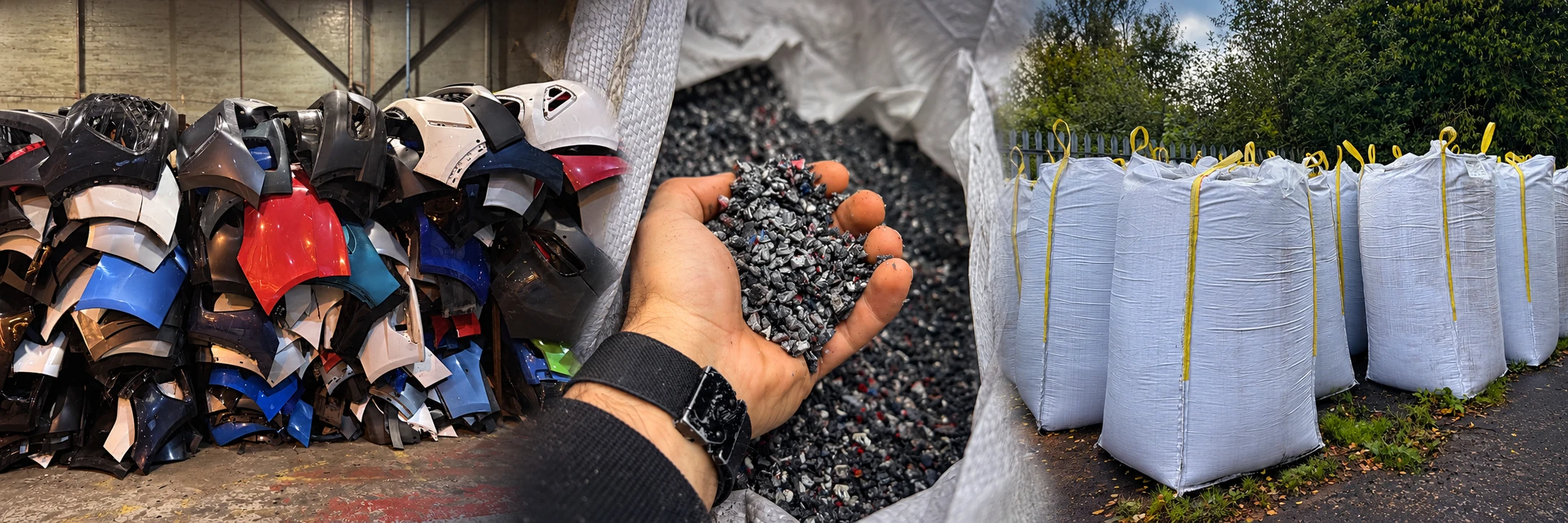
A modern bumper is, by weight, mostly polypropylene — one of the most recyclable plastics in use. Yet in plenty of workshops, bumpers still end up stacked against a wall until someone pays to have them taken away as general waste. That is a waste of material and of money, because a bumper that leaves your yard through the right route goes back into plastics manufacturing as high-quality regrind.
Here is exactly what happens to a bumper once it leaves a bodyshop with us — every step, from your workshop floor to the granulator.
Step 1: Collection from your workshop
It starts before the bumper ever comes off the car. Workshops on our bumper collection service are supplied with bins, cages and bumper racking, so removed bumpers and plastics are stored off the floor between visits rather than piling up in a corner. Collections run weekly, fortnightly, monthly or as one-offs, with no minimum volume, so the schedule matches your actual output.
On collection day, the material is loaded by a SEPA-registered waste carrier — our registration, WCR/R/3021810, is valid across Scotland, England and Wales and can be verified on SEPA's public register. Before the driver leaves, an electronic waste transfer note (eWTN) is issued, giving you the documentation your duty of care under section 34 of the Environmental Protection Act 1990 requires, on the spot. Keeping those notes for two years is the standard to work to.
Step 2: Sorting — and a second life for the best bumpers
Collected loads come back to our Hamilton facility, where capacity runs to more than 3,000 bumpers a day. The first job is sorting. Not every bumper should be granulated: good-condition bumpers are set aside, refurbished and resold as used parts. That is the "Reusing" in our motto — a bumper that can serve again as a bumper is worth more to the industry intact than as regrind.
Everything else — cracked, scuffed or beyond sensible repair — moves on to processing, alongside the other hard and soft plastics that arrive through our plastic waste collection service: wheel arch liners, side skirts, trims and grilles.
Step 3: Hand-stripping unwanted components
This is the step that separates good regrind from poor regrind. Bumpers don't arrive as clean plastic — they carry fixings, fittings and other components that have no place in a polymer stream. Our team strips those unwanted components out by hand before anything reaches the granulator.
Hand-stripping is slower than throwing whole units into a shredder, but it is why the output is worth having. Contamination is removed at source, piece by piece, so what goes into the machine is plastic and only plastic.
Step 4: Granulation into PP regrind
The stripped bumpers are then fed into the granulator, which cuts them down into small, consistent flakes of polypropylene — PP regrind. Because the input is a clean, single stream of automotive PP rather than mixed plastic of unknown origin, the regrind that comes out is consistent material that manufacturers can actually work with.
Step 5: Back into manufacturing — nothing to landfill
The finished regrind is supplied back into plastics manufacturing, where it becomes feedstock for new products. That closes the loop: material that was a disposal problem in a bodyshop yard re-enters the supply chain as a usable polymer, and nothing we collect is sent to landfill.
That is the full journey — Recycling, Reusing, Reinventing Value in practice. Waste bumpers granulated into regrind; good bumpers refurbished and resold; and, through our redundant stock purchase service, even unused genuine OEM parts bought from garages and reintroduced to the industry.
If your workshop is anywhere in Scotland, or in England down to Carlisle, Penrith and Newcastle, your bumpers can be on this journey from your next collection. Get in touch or call 0141 260 6602 to set up a schedule.
FAQ
Can cracked, painted or damaged bumpers be recycled? Yes. Damage that rules a bumper out of refurbishment doesn't rule it out of recycling — damaged bumpers are hand-stripped of unwanted components and granulated into PP regrind along with the rest of the stream.
What happens to bumpers that are still in good condition? They are not granulated. Good-condition bumpers are refurbished and resold as used parts, which keeps a serviceable component in use for longer before it is ever recycled.
How should we store bumpers between collections? You don't need to source anything yourself — we supply bins, cages and bumper racking to collection clients, so bumpers and plastics are stored off the floor and ready to load on collection day.
What paperwork do we receive at collection? An electronic waste transfer note (eWTN) is issued at every collection before the driver leaves. Retaining waste transfer notes for two years is the standard to work to under your duty of care.