Mechanical vs Chemical Recycling: What's Real and What's Hype
Read enough press releases and you could believe plastic recycling is about to be solved by chemistry: feedstocks "infinitely recycled", waste turned back into oil, every polymer reborn as good as new. Meanwhile, in yards and factories across the UK, an older and far less glamorous process quietly handles the overwhelming majority of plastic that actually gets recycled. Both approaches are real. Only one of them is doing the work today — and knowing the difference matters to anyone whose business produces plastic waste.
What mechanical recycling actually is
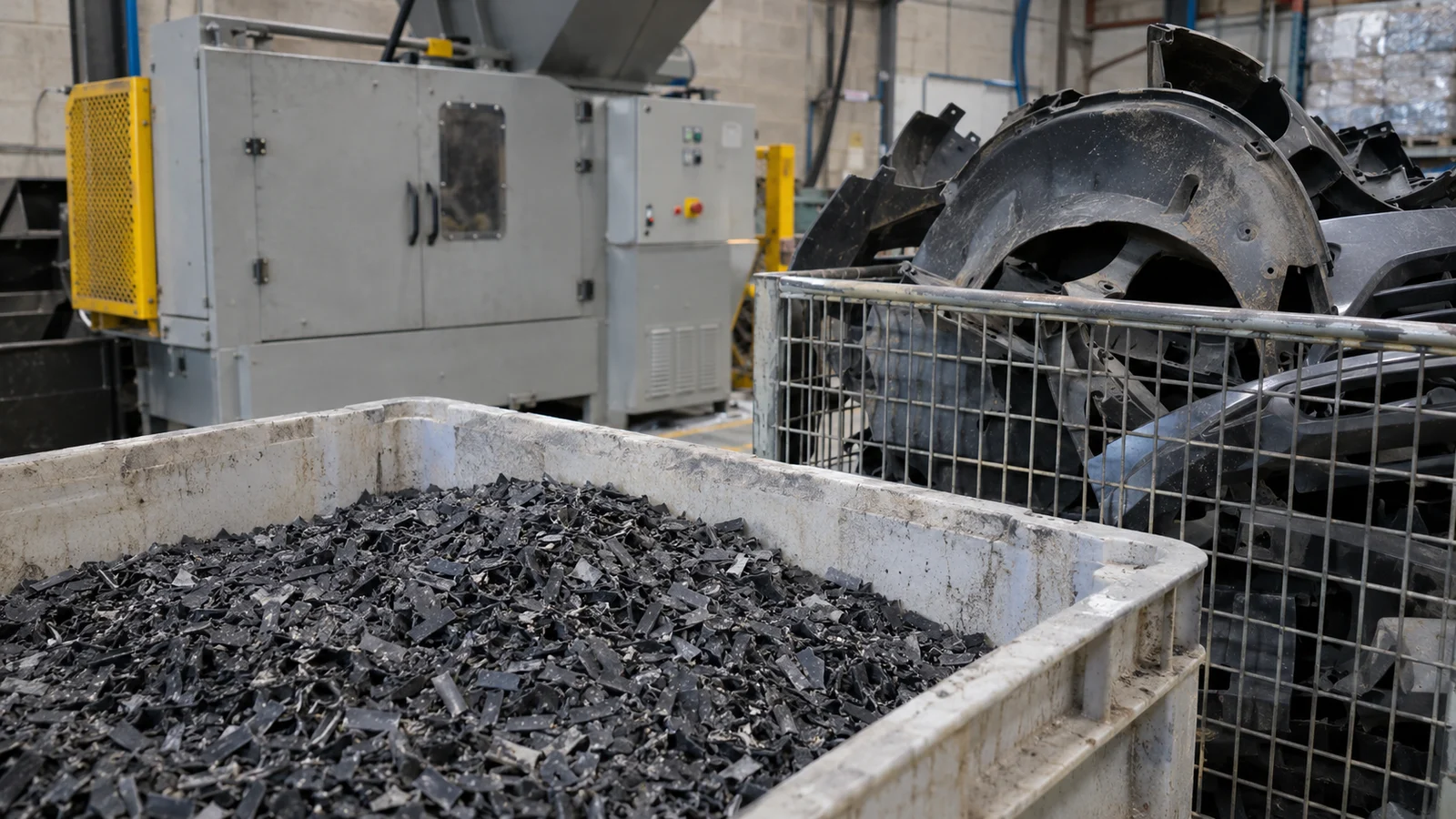
Mechanical recycling leaves the polymer chemically intact. Plastic is sorted by type, cleaned of labels, fixings and contamination, shredded, granulated and re-melted into pellets or regrind that a manufacturer can feed straight into a moulding machine. The molecules that left the factory as a bumper go back into production still being polypropylene — just in smaller pieces.
Its strengths are exactly what industry values: the process is proven, energy-efficient relative to making virgin polymer, and available now at commercial scale. Its limits are equally well known. It demands clean, well-sorted input — mixed or contaminated plastic makes poor regrind — and polymers gradually lose a little mechanical performance over repeated cycles, so output is matched to applications rather than used blindly.
What chemical recycling actually is
Chemical recycling — sometimes called advanced or feedstock recycling — breaks the polymer itself apart. Processes such as pyrolysis and depolymerisation use heat, pressure or solvents to reduce plastic to oils, monomers or other building blocks, which can then be refined and re-polymerised into material indistinguishable from virgin.
The promise is genuine: in principle it can digest mixed, laminated or contaminated plastic that mechanical routes reject, and the output carries no history of previous use. The reality is earlier-stage. Plants are comparatively few, energy demands are significant, yields depend heavily on what goes in, and a meaningful share of output ends up as fuel rather than new plastic — which is recovery, not recycling in the circular sense.
Side by side
| Mechanical recycling | Chemical recycling | |
|---|---|---|
| What happens to the polymer | Stays intact; cleaned, shredded, re-melted | Broken down to oils or monomers, rebuilt |
| Maturity in the UK | Proven, operating at commercial scale | Emerging; limited capacity, projects developing |
| Best suited to | Clean, single-type streams (e.g. PP) | Mixed, laminated or contaminated plastic |
| Energy intensity | Comparatively low | Comparatively high |
| Output quality | Very good from clean input; application-matched | Virgin-equivalent in principle |
| Honest summary | The workhorse | The promising apprentice |
Where the hype lives
The hype is rarely in the chemistry; it is in the tense. Chemical recycling is routinely described in the present tense — solving, closing the loop, eliminating waste — when much of it is still scaling up. The risk is practical: businesses told that "soon, everything will be recyclable anyway" stop doing the one thing that makes recycling of any kind work, which is keeping plastic clean and separated at source. A mixed, contaminated skip is a poor input for a granulator today and would be a poor input for a pyrolysis plant tomorrow. Sorting is never wasted effort.
What this means for automotive plastic
Automotive plastic is, luckily, mechanical recycling's ideal customer. Bumpers, wheel arch liners, trims and lamp housings are dominated by polypropylene — a polymer that mechanically recycles well — and a workshop generates them as naturally separable, identifiable items rather than anonymous mixed waste. Kept as their own stream, they need no future technology at all.
That is the model Eco Auto Solutions runs: dedicated bumper collection and plastic waste collection keep automotive plastic out of mixed waste, and the material is hand-stripped and granulated into PP regrind supplied back to manufacturing, with nothing to landfill. No hype required — the loop already closes, across all of Scotland and the North of England. If your workshop's plastic is still going out mixed, start the conversation at our contact page or on 0141 260 6602.
FAQ
Is chemical recycling happening in the UK right now?
At a modest scale, yes — pilot and early commercial plants exist, and more are planned. But current UK recycling volume remains overwhelmingly mechanical, and that balance will take years to shift even on optimistic timelines.
Does mechanically recycled plastic always mean lower quality?
No. Quality tracks the input: regrind from a clean, single-polymer stream performs close to virgin material and is specified into demanding products. Degradation becomes an issue over many repeated cycles or with contaminated feedstock, which is why input quality is the whole game.
Is pyrolysis the same thing as burning plastic?
No, though the confusion is understandable. Incineration burns plastic for energy; pyrolysis heats it without oxygen so it decomposes into oils and gases that can become feedstock for new material. The caveat is that where pyrolysis output is used as fuel, the outcome is closer to energy recovery than to recycling.
Should a workshop wait for chemical recycling before sorting its plastic?
The opposite. Every recycling route — present or future — works better with clean, sorted input, and single-stream automotive plastic is valuable to mechanical recycling today. Waiting just sends recyclable material to disposal in the meantime.