Net Zero for Bodyshops: Practical First Steps That Cost Nothing to Start
Net zero has a vocabulary problem. Scopes, baselines, offsets, pathways — it reads like something written for airlines and cement plants, not for a repair business getting cars out of the door. Underneath the vocabulary the idea is plain: measure what your business emits, reduce what you can, and deal honestly with the rest. And much of the "reduce" column needs no capital spend at all — just decisions. Here is the checklist worth starting with.
☐ Find your baseline in the paperwork you already have
You cannot shrink a number you have never seen. Twelve months of energy bills, fuel receipts and waste invoices already describe most of a bodyshop's footprint. An afternoon with a spreadsheet turns them into a crude baseline — and crude is fine. The point is a starting number to compare against next year, not an audit-grade inventory.
☐ Hunt the energy your shop uses while doing nothing
Walk the building after close one evening. Compressors holding pressure overnight for nobody, extraction running in an empty booth, lighting across bays that finished at four. Idle load is emission without production, and killing it is a matter of switches, timers and habits rather than investment. The spray booth deserves particular attention — it is usually the hungriest thing on site, so scheduling paint work in batches rather than firing the booth for single panels does more than any poster in the brew room.
☐ Repair more, replace less — where the method allows
Every panel or bumper repaired instead of replaced avoids the manufacture and transport of a new part, which is where a large share of a repair's footprint hides. The boundary is non-negotiable: repair decisions follow the vehicle manufacturer's methods and the shop's own competence, in line with the expectations set by standards such as BS 10125. But within that boundary, a shop that quotes repair where repair is proper is cutting carbon and cost in the same motion.
☐ Stop sending plastic to disposal
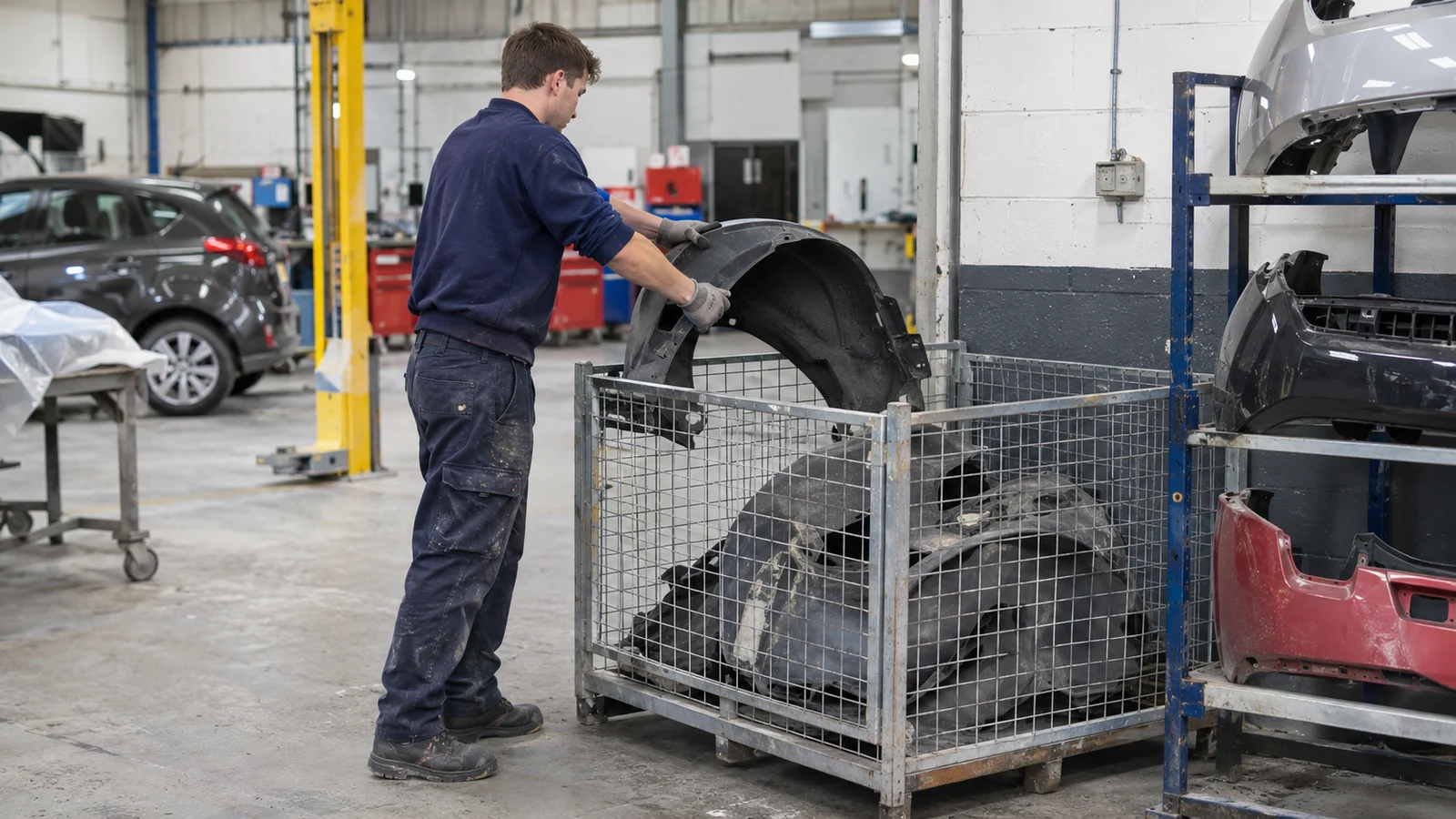
The replaced bumpers, trims, liners and lamps a bodyshop generates are made of material that manufacturing wants back. Routed into general waste they become landfill or incineration; segregated, they become feedstock. A dedicated plastic waste collection turns the same pile into granulated PP regrind that goes back into making new products — displacing virgin polymer, which is the carbon saving — with nothing sent to landfill. Segregation itself is a behaviour change, not a purchase: the same waste, sorted at the point it comes off the car.
☐ Ask your suppliers and contractors one question
"Where does it go, and can you show me?" A shop's footprint extends through everyone it buys from and everyone who takes things away. Suppliers with real answers — documented destinations, transfer notes, named processes — strengthen your own story; suppliers who change the subject are telling you something too. You do not need to audit anyone. You need to ask, and to prefer the ones who answer.
☐ Write one honest page
Not a glossy report — a single page stating your baseline, the three or four actions above that you have actually taken, and what you intend to do next year. Keep it with the evidence: the bills, the transfer notes, the collection records. When a fleet customer or an insurer asks about sustainability — and they increasingly do — the shop with one honest page beats the shop with ten adjectives.
What to skip for now
Offsets bought to compensate for emissions you have never measured, certificates from schemes nobody can explain, and any investment case built before the baseline exists. None of it is wrong forever; all of it is premature until the checklist above is done.
Eco Auto Solutions handles the plastic line of that checklist for workshops across all of Scotland and the North of England — including Carlisle, Penrith, Newcastle, Middlesbrough, York, Leeds, Bradford, Manchester and Liverpool. If segregated recycling is where your net zero starts, reach us through our contact page or on 0141 260 6602.
FAQ
Is net zero a legal requirement for bodyshops?
No. The UK's net zero commitment is a national target, not an obligation on individual small businesses. The pressure arriving at bodyshop level is commercial instead: insurers, work providers and fleet customers asking about environmental practice when awarding work.
What's the difference between net zero and carbon neutral?
Carbon neutral is commonly achieved largely by buying offsets against unchanged emissions. Net zero expects genuine, deep reductions first, with offsetting reserved for the residue that cannot be eliminated. For a small business, the practical reading is: reductions are the work, offsets are the remainder — not the other way round.
Where do a bodyshop's emissions actually come from?
Three places, roughly: what you burn on site — gas heating, the booth, site vehicles; what you buy in as electricity; and everything embedded in the chain around you — parts, paint, deliveries, waste. The third is usually the largest and least visible, which is why repair-versus-replace decisions and waste routing count for more than they look.
Does recycling our plastic really reduce carbon, or just divert waste?
Both, and the first matters more. Recycled polypropylene re-entering manufacturing displaces virgin polymer, which takes substantially more energy to produce from oil feedstock — that displacement is the carbon saving. Diversion from landfill is the visible benefit; the avoided virgin production is the bigger one.