On-Site Waste Storage Rules for UK Workshops: Your Questions Answered
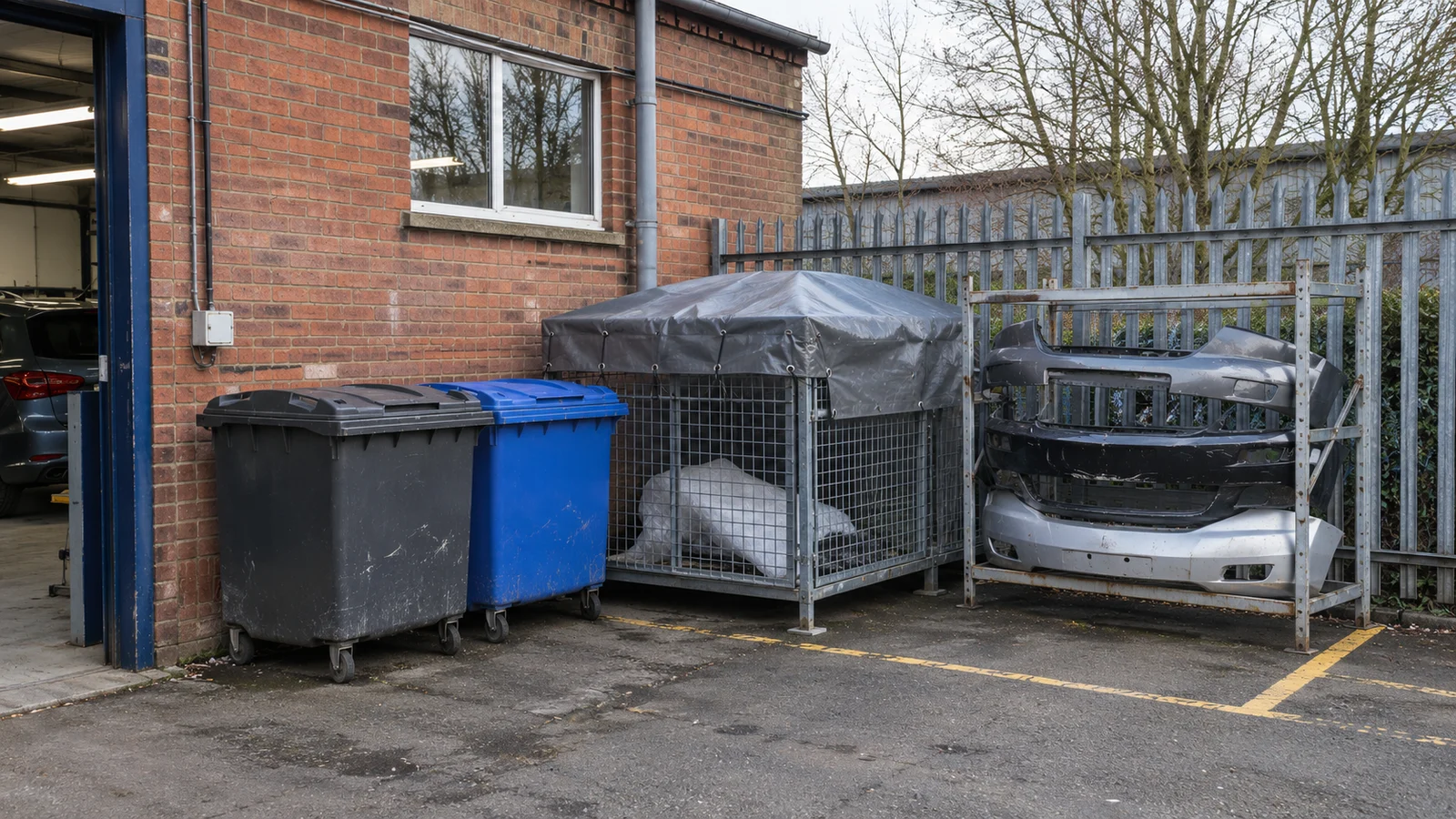
Most workshop owners know the rules kick in when waste leaves the site — registered carriers, transfer notes, legitimate destinations. Fewer realise the law is watching the weeks before the van arrives too. Waste sitting in your yard is still your legal responsibility, and how it sits there is a compliance question in its own right. Here are the questions garage owners actually ask about on-site storage, answered plainly.
Is there a specific law about storing waste on site?
Yes — the duty of care under section 34 of the Environmental Protection Act 1990, which applies across England, Scotland and Wales. It requires anyone who produces or holds waste to take reasonable measures to keep it secure and prevent its escape, from the moment it becomes waste until it is handed to an authorised person. "Holding" includes storage, so a pile in the yard sits squarely inside the duty. SEPA enforces this in Scotland and the Environment Agency in England, and both read a site's storage arrangements as evidence of whether the duty is being taken seriously.
What does "secure" actually mean in practice?
The legislation talks in principles rather than measurements, but the practical test is simple: can your waste escape, be scattered, leak, or be taken without your knowledge? Lightweight plastics that can blow across neighbouring property fail the test. So does anything stored where the public or scrap collectors can help themselves — because if your waste ends up fly-tipped, having "lost" it is not a defence; the duty of care follows the material. Contained, covered where wind matters, and inside a controlled area is the standard to aim at.
Do different wastes have to be stored separately?
Hazardous waste — in Scotland, special waste — must never be mixed with general waste, so oils, filters, fuels, coolants and solvent-contaminated materials need their own dedicated, labelled containment, with liquids provided with secondary containment so a failed drum cannot reach a drain. Non-hazardous streams do not legally require separation from each other, but mixing them is self-defeating: clean segregated bumpers and trims are recyclable material, while the same items buried in general waste are contaminated disposal. Segregation is where compliance and value point the same way.
How long can waste stay on site?
For waste you produced yourself, awaiting collection, there is no fixed statutory clock — but indefinite accumulation is not the answer either. Storage is meant to be genuinely temporary and incidental to collection; a growing mountain starts to look less like storage and more like unauthorised keeping or disposal, which is a different and more serious conversation with the regulator. The working rule: hold what a sensible collection cycle requires and no more. If material routinely outgrows the space before pickup, the schedule is wrong, not the yard.
Does the escape of waste really come back on me?
It can. If plastics blow from your yard onto the road, or material taken from an unsecured pile appears fly-tipped in a lay-by, the producer's duty of care is engaged even though someone else moved it. This is also why waste should only ever leave with a registered carrier whose details you have checked — Eco Auto Solutions, for instance, is a SEPA-registered carrier (WCR/R/3021810, valid across Scotland, England and Wales and verifiable on SEPA's public register), and an electronic waste transfer note is issued at every collection before the driver leaves, closing the loop your storage opened.
What's the easiest way to get storage right?
Containment designed for the material, in a defined area, emptied on a cycle that matches your output. For automotive plastics that means proper bins, cages and bumper racking rather than a corner and hope — equipment Eco Auto Solutions supplies to its collection clients — paired with a plastic waste collection running weekly, fortnightly or monthly as your volume demands, with alloy wheel collection alongside where wheels accumulate too. We cover all of Scotland and the North of England — including Carlisle, Penrith, Newcastle, Middlesbrough, York, Leeds, Bradford, Manchester and Liverpool. To put your storage and collection on a proper footing, ring 0141 260 6602 or drop us a line through our contact page.
FAQ
Do I need a permit or licence just to store my own waste on site?
Generally no — temporarily and securely storing waste you produced, at the place you produced it, pending collection is normally exempt from permitting. The position changes if you start bringing in waste from elsewhere, storing large quantities long-term, or treating it, so growth plans in that direction warrant advice from SEPA or the Environment Agency first.
Does waste stored outside have to be covered?
Not universally, but the secure-storage principle decides it. Lightweight plastics that wind can lift, and any material that rain would degrade or wash contaminants from, should be covered or contained. Dense, stable items are more forgiving — judge by whether weather or wind could cause escape or pollution.
Can I store customer vehicles' old parts with my general workshop waste?
Once a removed part is waste, it is your waste regardless of whose car it came from, and the same storage duties apply. The better question is routing: old bumpers, trims and lamps are worth keeping as a segregated recyclable stream rather than paying to dispose of them in general waste.
Who is responsible if my waste contractor stores collected material badly?
Once waste transfers to an authorised carrier, day-to-day responsibility for it moves with it — but your duty of care includes taking reasonable steps to hand waste only to legitimate operators headed for legitimate destinations. Checking a carrier's registration on the public register is the minimal, documented step that shows you did.