How to Identify Plastic Types: A Workshop Guide to Resin Codes
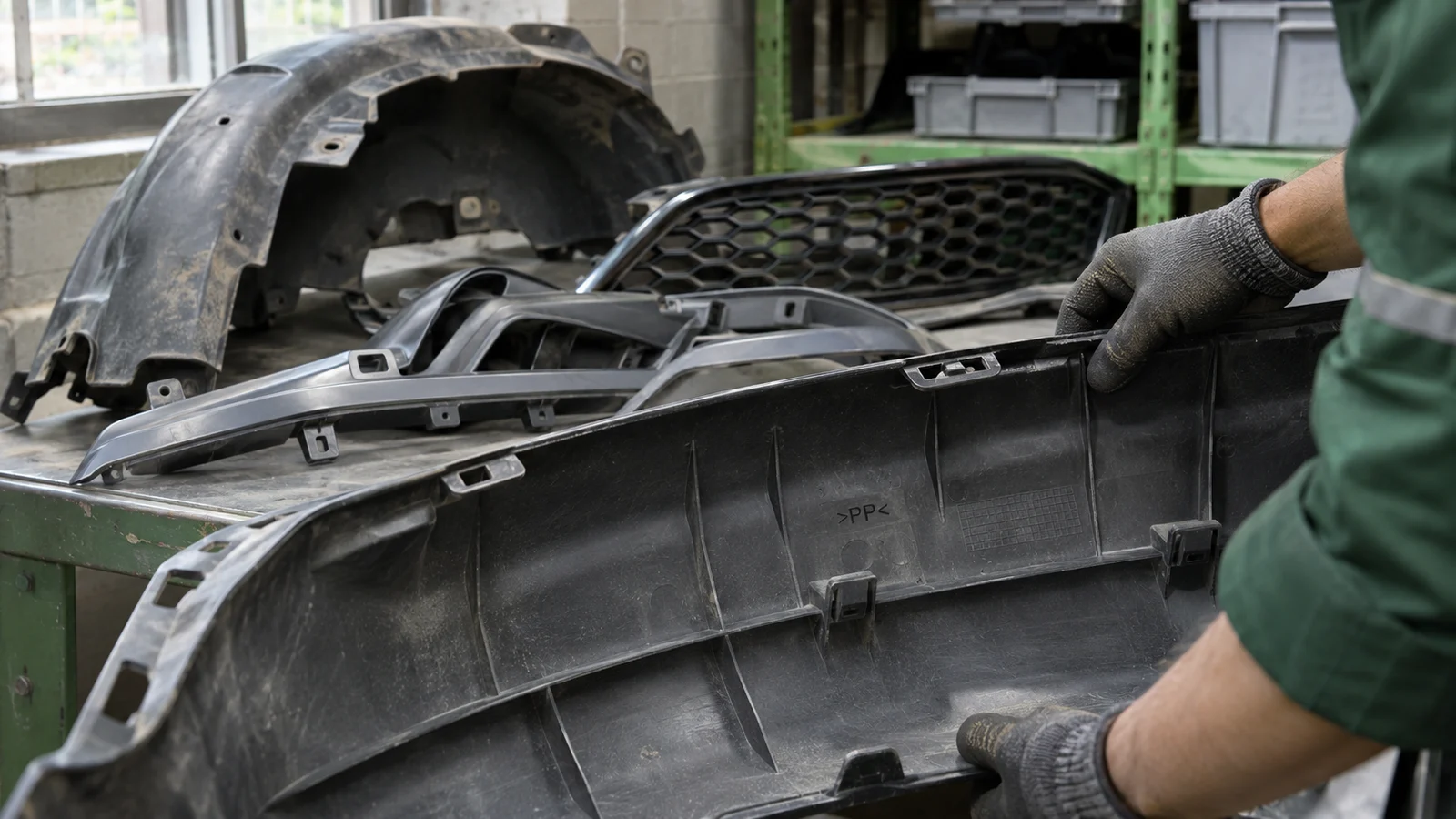
Turn over almost any plastic part that has come off a car and, moulded into the back, you'll find a small cluster of letters between angle brackets — something like >PP/EPDM-TD15<. Most technicians have seen it a thousand times without ever decoding it. That marking is the part telling you exactly what it's made of, and once you can read it, sorting a workshop's plastic waste stops being guesswork. This guide walks round a typical car, marking by marking.
Two systems, one habit
There are two kinds of marking you'll meet. The first is the familiar resin identification code — the triangle of chasing arrows with a number from 1 to 7 — used mainly on packaging: 1 is PET, 2 is HDPE, 3 is PVC, 4 is LDPE, 5 is PP (polypropylene), 6 is PS (polystyrene) and 7 is "other". It turns up on fluid bottles, caps and some trim, and the number worth memorising is 5, because polypropylene dominates automotive plastics.
The second system is the one car parts actually use: ISO material markings between angle brackets. These are more precise. In >PP/EPDM-TD15<, the PP is polypropylene, EPDM is a rubber blended in for flexibility and impact resistance, and TD15 means roughly fifteen per cent talc filler for stiffness. You don't need to parse every suffix — the habit that matters is reading the letters before the slash, because they name the base polymer, and the base polymer decides which pile the part belongs in.
A walk round the car
Start at the front bumper. Flip it and look near a mounting edge or behind the number plate recess: on most modern cars you'll find PP or a PP blend such as PP/EPDM. That's why bumpers are the backbone of automotive plastic recycling — a consistent, high-volume, single-polymer stream, which is exactly what a dedicated bumper collection is built around.
Move to the wheel arch liners and undertrays: PP again, often with fibre or talc fillers, and frequently marked PP-T or PP-GF. Side skirts and exterior trims are usually PP too, though painted finishers sometimes turn out to be ABS. The grille is a common switch point — many are ABS or an ABS/PC blend, chosen for the crisp mouldings and chrome-effect plating it takes well.
At the headlights, the lens is almost always PC (polycarbonate) — look for >PC< on the lens tab — while the housing behind it is typically PP or ABS. That mix of polymers, plus bulbs and electronics, is why a light unit is a stripping job rather than a single-stream item. Inside the cabin, dash components and pillar trims swing between PP, ABS and PC/ABS blends, with the marking usually hidden on a clip face or rear rib.
When there's no marking to read
Older parts, deeply weathered mouldings and heavily painted faces sometimes offer nothing legible. A few practical cues help. PP has a slightly waxy feel and flexes without whitening where ABS tends to be harder, glossier on unpainted faces, and creases white under stress. Unfilled PP floats in water; ABS and PC sink — a surprisingly useful bench test for an offcut. But the honest rule for a busy workshop is simpler: when a part can't be identified with confidence, keep it out of the clean PP pile and let the recycler's sorters make the call. One mystery polymer melted into a batch does more damage than a dozen parts set aside.
Why the reading habit pays
Recyclers can only make manufacturing-grade material from feedstock they can trust. A load of bumpers, liners and skirts that is genuinely all polypropylene can be hand-stripped of clips and fixings and granulated straight into PP regrind that goes back into manufacturing — whereas a contaminated mixed load drags everything down to the lowest common use. Teaching the whole team to glance at the angle brackets before a part hits the pile is the cheapest quality-control step in the chain.
Eco Auto Solutions collects bumpers, headlights, hard and soft plastics and alloy wheels through a scheduled plastic waste collection, hand-strips and granulates everything collected, and sends nothing to landfill — across all of Scotland and the North of England. Want a trained eye on what's actually in your pile? Ring 0141 260 6602 or tell us what you're sorting.
FAQ
What does a marking like >PP+EPDM-TD20< actually mean?
Polypropylene as the base polymer, blended with EPDM rubber for impact performance, with about twenty per cent talc filler for stiffness. For sorting purposes the key information is the first term: it's a PP part and belongs with the PP stream.
Do fillers like talc or glass fibre stop a PP part being recycled?
No — filled PP is still recycled, and fillers are a normal feature of automotive grades. What matters is knowing the filler is there, because it changes the properties of the regrind. That's one reason consistent, well-identified streams are worth more than mixed ones.
Why is code 5 polypropylene so common in cars?
It's light, cheap, tough, resists chemicals and moulds into complex shapes — the exact brief for bumpers, liners and trims. Its dominance is also good news for recycling: one polymer covering so many parts makes clean single-stream collection realistic.
Is it safe to use a flame or melt test to identify plastic?
Avoid it in a workshop. Burning unknown polymers can release unpleasant or harmful fumes — PVC especially — and the results mislead the untrained. Markings, feel, flex and the float test will identify the overwhelming majority of car plastics without setting anything alight.