The Problem with Landfilling Automotive Plastic — and the Alternative
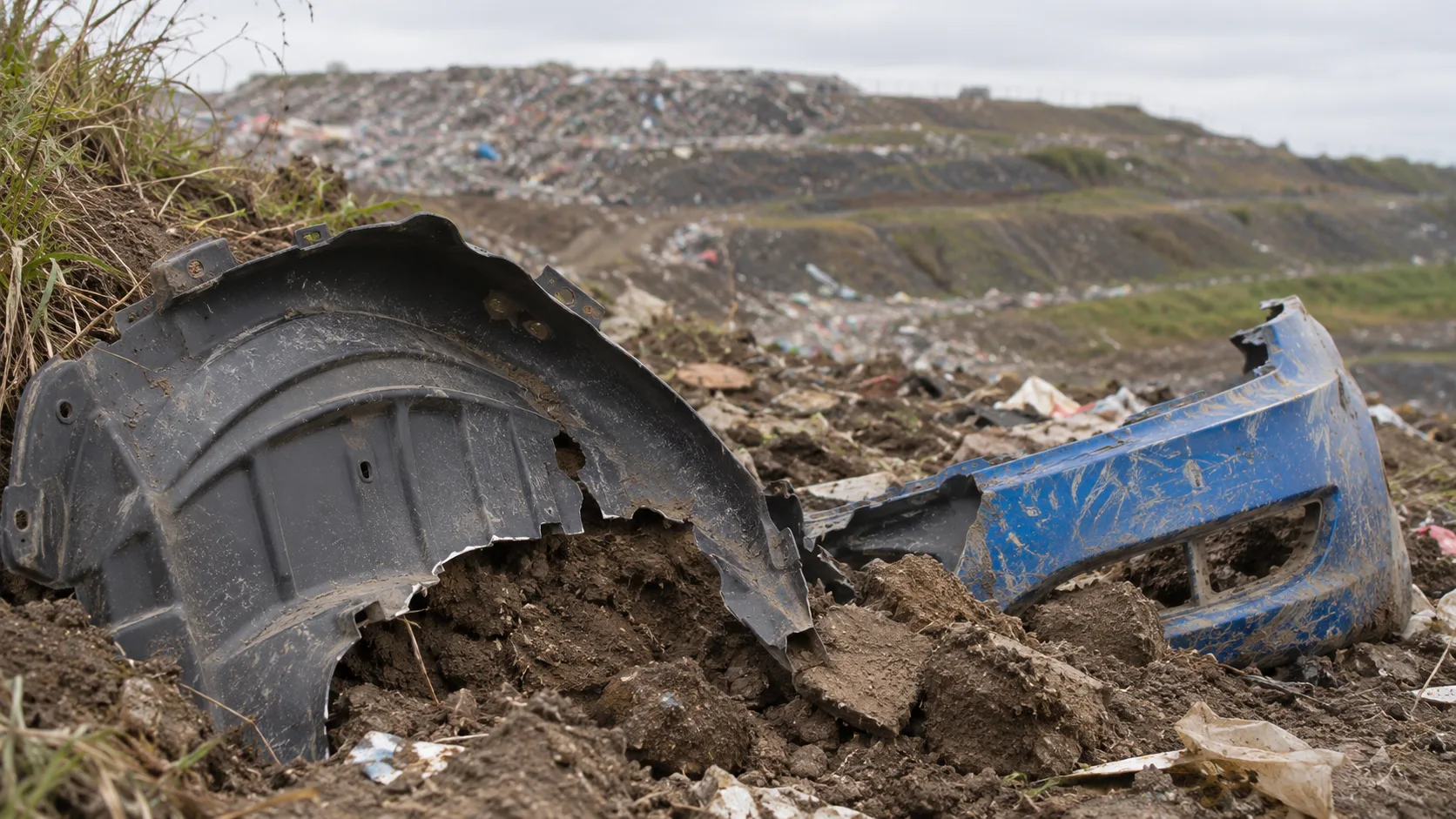
A bumper is engineered to shrug off stone chips, road salt, ultraviolet light and ten winters of motorway spray. That durability is a virtue on the car and a problem in the ground, because landfill doesn't un-engineer anything. Bury a polypropylene bumper and it does what it was designed to do: resist degradation, indefinitely. The skip that takes a workshop's plastics to landfill isn't making them go away. It's putting them somewhere harder to see.
Landfill doesn't dispose of plastic — it stores it
Organic waste in landfill breaks down, however messily. Automotive plastics, overwhelmingly polypropylene and similarly stable polymers, essentially don't. On any timescale that matters to a business or a person, a landfilled bumper is permanent: it occupies void space in a finite hole, it fragments rather than disappears, and the energy and material that went into making it are written off entirely. Meanwhile the commercial logic runs the wrong way too. Landfill is taxed precisely to discourage it, void space is a shrinking resource, and the long-term direction of disposal costs points steadily upward. A workshop that defaults its plastics into general waste is paying a rising price for the privilege of wasting a recyclable material.
The two routes, side by side
| Landfill route | Recycling route | |
|---|---|---|
| What happens to the material | Buried intact; persists indefinitely | Stripped, sorted and granulated into new raw material |
| What the material becomes | Nothing — void space filled | PP regrind feeding manufacturing, including new components |
| What your yard gains | A skip that fills with everything | A clean, segregated stream in purpose-made containment |
| Cost direction over time | Upward, by design | Stable or better — recyclers want the material |
| The duty-of-care story | "We threw it away" | "We can show where it went and what it became" |
| What's left in fifty years | The same bumper, underground | A material still circulating |
Why automotive plastic deserves better than burial
Most plastic waste is a recycler's nightmare: mixed polymers, food contamination, small fragments, films. Automotive plastic is the opposite. Bumpers, wheel arch liners, trims and grilles are large, identifiable mouldings in a narrow range of polymers — predominantly polypropylene — and they accumulate exactly where repair happens, in volumes worth collecting. A bodyshop's plastic pile is about as close to ideal recycling feedstock as commercial waste gets. Sending it to landfill isn't just environmentally backward; it's squandering the one waste stream a workshop produces that genuinely wants to be a material again.
What the alternative looks like in practice
The alternative is a dedicated route rather than a general one. A segregated plastic waste collection takes bumpers, liners, skirts, trims and grilles as their own clean stream; a specialist bumper collection handles the highest-volume item in the pile. Collected material is hand-stripped of fixings and contaminants, then granulated into PP regrind supplied back into manufacturing — which is how Eco Auto Solutions runs its own process, with nothing going to landfill. The loop is short and tangible: the plastic that came off a damaged car becomes raw material for new product, sometimes for the automotive industry it left.
The honest comparison, then, isn't between two ways of getting rid of waste. It's between ending a material's life and continuing it — at a workshop's gate, with the same amount of effort either way.
If your plastics are still going out with the general waste, rerouting them is one conversation. Eco Auto Solutions collects segregated automotive plastics across all of Scotland and the North of England — including Carlisle, Penrith, Newcastle, Middlesbrough, York, Leeds, Bradford, Manchester and Liverpool. Call 0141 260 6602 or reach us through our contact page and we'll set the route up.
FAQ
Does automotive plastic ever break down in landfill?
Not meaningfully. Polypropylene and the other polymers common in vehicle trim are chemically stable and were specified for outdoor durability; in landfill they fragment physically over very long periods rather than decomposing. For practical purposes, a buried bumper should be thought of as permanent.
Isn't energy-from-waste a better option than landfill for plastics?
It recovers something, which burial doesn't, and for genuinely unrecyclable residues it has a role. But burning polypropylene destroys a polymer that could have been reused as material, and recycling it preserves far more of the original value. For a clean, segregated automotive stream, recycling sits clearly above incineration in the hierarchy.
Does painted or damaged plastic have to go to landfill?
No. Paint and damage rule out reuse of the part, not recycling of the polymer. Cracked, scuffed and painted bumpers are routine recycling feedstock — processing deals with coatings and fixings — which is why even a badly damaged bumper belongs in the segregated stream, not the general skip.
Our volumes are modest — is a recycling route still realistic?
Yes. The material doesn't need to arrive in bulk to be worth recovering; it needs to arrive clean and segregated. Collection schedules exist down to monthly and one-off visits precisely so that lower-volume sites can keep plastics out of landfill without changing how they work.