Waste Documentation: Building an Audit File That Defends Itself
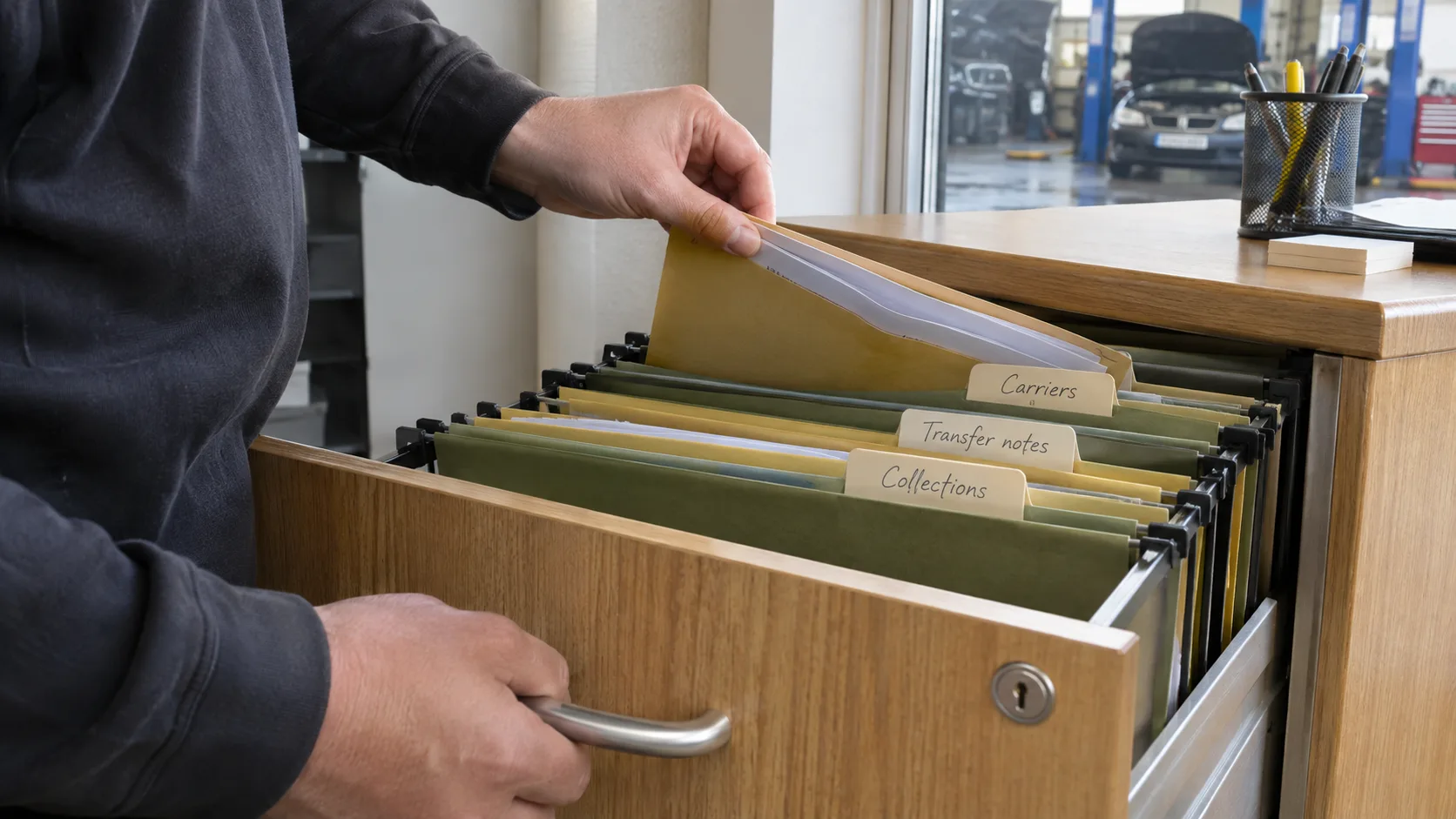
There are two kinds of waste file. One is a drawer: paperwork goes in whenever it happens to arrive, and when an inspector, insurer or customer asks a question, somebody spends an afternoon reconstructing the answer. The other is an argument already written — a file organised around the questions it will one day be asked, so that answering takes minutes and nobody has to improvise. The difference between the two isn't effort. It's knowing the questions in advance. There are really only four.
Question one: who took your waste?
The duty of care that applies to every business producing waste in Scotland, England and Wales makes this the opening question of any audit: waste may only be handed to someone authorised to take it. Your file answers with evidence, not recollection — a record of each contractor's carrier registration, checked against the public register (SEPA's in Scotland, the Environment Agency's in England) rather than taken from a letterhead. It takes minutes to verify a waste carrier on the register, and a dated note or screenshot of that check, refreshed from time to time, converts "we believed they were registered" into "we confirmed it, and here's when". The first sentence of a file that defends itself is always we checked.
Question two: what did they take, and when?
This is the transfer note's job, and it's where drawers fail quietest. Every handover of controlled waste should generate a note identifying the parties, the date, and a proper description of the waste — and "proper" is doing real work in that sentence. A description that genuinely matches what left the yard, with its classification, is what lets the chain of custody survive scrutiny; a vague one infects every later document that relies on it. Frequency matters as much as quality: if your yard sees collections weekly but your file sees paperwork quarterly, the gaps are findings waiting to be found. It's one reason electronic notes have been such a practical improvement — our own collections generate an eWTN before the driver leaves, so the record exists the moment the material does, already legible and already filed.
Question three: where did it go?
Strictly, the producer's formal paperwork trail ends at the handover — but audits, insurers and increasingly customers push one question further, and the strong file is ready for it. What becomes of the material? For some streams the honest answer is murky, which is itself worth knowing before someone else discovers it for you. For automotive plastics it needn't be: material from our plastic waste collection rounds is hand-stripped, granulated into PP regrind and supplied back into manufacturing, with nothing going to landfill — a destination you can state in a sustainability questionnaire and stand behind in a room. A short written summary of each stream's end point, obtained from each contractor, is one page that answers the question audits most enjoy asking.
Question four: can you show me two years of it?
The last question is about depth. Two years' retention of transfer notes is the standard to work to, which means today's file is defending decisions made many collections ago — so organisation is what turns retention from a pile into proof. Whatever the format, the test is retrieval: can you produce every note for a named month, for a named stream, inside five minutes? Chronological within stream usually beats one long date-ordered stack, and electronic notes make the whole exercise searchable rather than archaeological. A file you can navigate under pressure is the finished article; a complete file you can't is still a drawer.
Let the file build itself
The cheapest audit file is the one assembled by your collection routine rather than by an annual panic. Every pickup we make generates its eWTN on the spot, and the destination answer is the same every time. If the plastics section of your file is the thin one, we collect across all of Scotland and the North of England — start the file with your next collection or call 0141 260 6602.
FAQ
Are electronic waste transfer notes as valid as paper ones?
Yes — what matters is the content and its retention, not the medium. Electronic notes carry the same information with practical advantages paper can't match: they arrive at the moment of collection, can't be lost in a cab or a coat pocket, and make a two-year archive searchable in seconds.
We've found past collections with no transfer note at all. Can the gap be repaired?
Not retroactively pretended away — a missing note is missing. What you can do is document the gap honestly: record what was collected and by whom as best you can establish it, note the corrective step taken, and make sure the routine now produces a note every time. Auditors treat a found-and-fixed gap very differently from a concealed one.
Why is two years the retention figure to work to?
It's the established standard for waste transfer notes, and it reflects how questions actually arrive — often long after the collection they concern, when memories are useless and only the record remains. Keeping the full two years, well organised, means the answer exists whenever the question lands.
Who in the business should own the audit file?
One named person, with a deputy — files owned by "the office" are owned by nobody. Ownership means receiving or filing each note as it's generated, running the periodic carrier re-checks, and being the person who can retrieve any document on request. In most workshops it's an hour or two a month once the routine exists.