Waste Transfer Notes Explained for UK Garages: Paper Notes vs the Electronic eWTN
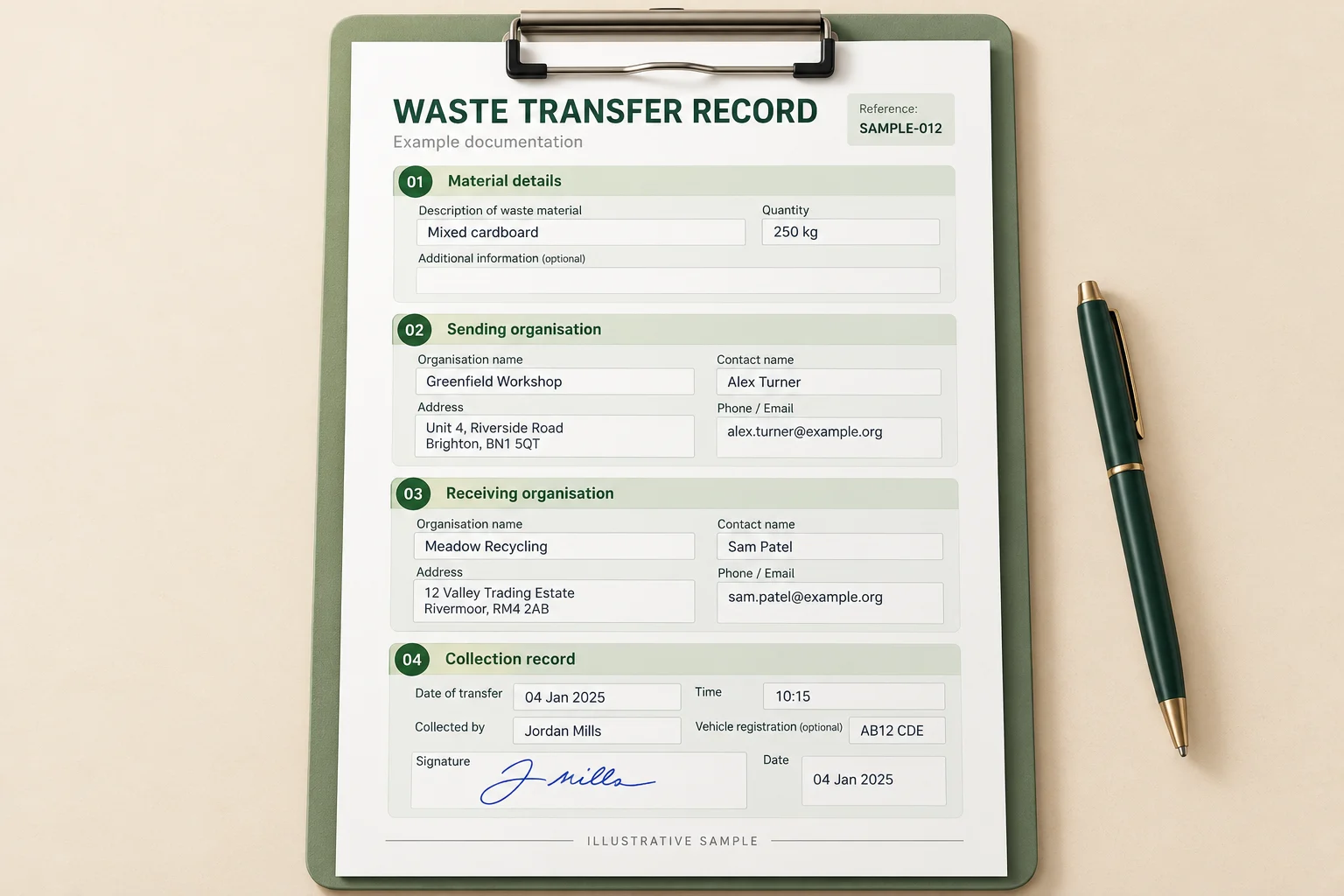
Every load of waste that leaves your garage should leave with paperwork. The waste transfer note — WTN for short — records what the waste was, who handed it over and who took it away. It is the backbone of the duty of care under section 34 of the Environmental Protection Act 1990, which applies across England, Scotland and Wales. If a regulator ever asks what happened to your bumpers, plastics or wheels, the transfer note is your answer.
This guide covers what a transfer note must record, how long to keep it, and why garages are moving from paper to the electronic version, the eWTN.
What a waste transfer note actually is
A waste transfer note is a written record created every time controlled waste passes from one party to another — typically from your garage to a registered waste carrier. Scrap bumpers, broken headlights, trims, liners and alloy wheels from a commercial workshop all count as controlled waste, so each collection should generate a note.
At a minimum, a transfer note describes the waste, states the quantity and how it is contained, identifies both parties — including the carrier's registration details — and records the date and place of transfer. Both sides keep a copy. The standard to work to is a two-year retention period, so a garage with weekly collections will build up a meaningful archive surprisingly quickly.
The note matters because the duty of care does not end at your gate: the transfer note is your evidence that you checked who was taking your waste and described it honestly.
Where paper notes fall down
Paper transfer notes do the job legally, but they suit a filing cabinet better than a working bodyshop. The failure points are familiar: notes left in van cabs, smudged with primer or never handed over because the driver was in a hurry. Carbon copies fade. Someone files a note in the wrong month, and two years later nobody can find the record for the one collection an inspector asks about.
None of this is misconduct — it is just what happens when a busy workshop relies on loose paper. But the duty of care does not distinguish between a note that was never issued and a note you cannot produce. Either way, the evidence is missing.
The electronic eWTN: the same document, without the filing cabinet
An electronic waste transfer note records the same information as a paper note — waste description, quantity, parties, carrier registration, date — but is generated and stored digitally. That changes three things in practice.
First, the note exists the moment the collection happens, time-stamped and legible, rather than depending on a driver remembering a pad. Second, retrieval takes seconds: if SEPA in Scotland or the Environment Agency in England asks for your records, you can produce every note for the retention period without opening a drawer. Third, nothing fades, tears or goes missing in a glovebox.
At Eco Auto Solutions we issue an eWTN at every collection, before the driver leaves the yard. Whether we are there for bumper collection, plastic waste collection or alloy wheel collection, the paperwork is complete when the van pulls away — there is no chasing documents afterwards, and your compliance record builds itself collection by collection.
Checking the other half of the note
A transfer note is only as good as the carrier named on it. Before signing anything, confirm your collector holds a valid waste carrier registration — it is a public record and takes minutes to check. Eco Auto Solutions is a SEPA-registered waste carrier, registration WCR/R/3021810, valid across Scotland, England and Wales and verifiable on SEPA's public register. Putting a registered carrier's details on every note is the simplest compliance win available to any garage.
Get the paperwork handled for you
If keeping transfer notes in order has been an afterthought, the easiest fix is a collector who does it automatically. We collect bumpers, headlights, hard and soft plastics and alloy wheels across all of Scotland and England down to Carlisle, Penrith and Newcastle, on weekly, fortnightly, monthly or one-off schedules with no minimum volume — and every visit ends with an eWTN in your records. Get in touch or call 0141 260 6602 to set up a collection schedule.
FAQ
Do I need a waste transfer note for every collection? Yes. Each transfer of controlled waste from your garage to a carrier should be documented. With a regular schedule using eWTNs, this happens automatically at every visit rather than being something you have to remember.
How long should a garage keep waste transfer notes? Work to a two-year retention period. Electronic notes make this painless because the archive builds itself and nothing can be mislaid.
Is an electronic waste transfer note legally equivalent to paper? An eWTN records the same information a paper note does — the waste, the parties, the carrier's registration and the transfer details — in a form that is easier to retrieve and harder to lose when a regulator asks for records.
Who regulates waste from my garage? SEPA regulates waste in Scotland and the Environment Agency in England. The duty of care under s.34 of the Environmental Protection Act 1990 applies across England, Scotland and Wales, so the record-keeping expectations are consistent wherever your workshop is.