What Happens to Scrap Alloy Wheels and Headlights After Collection?
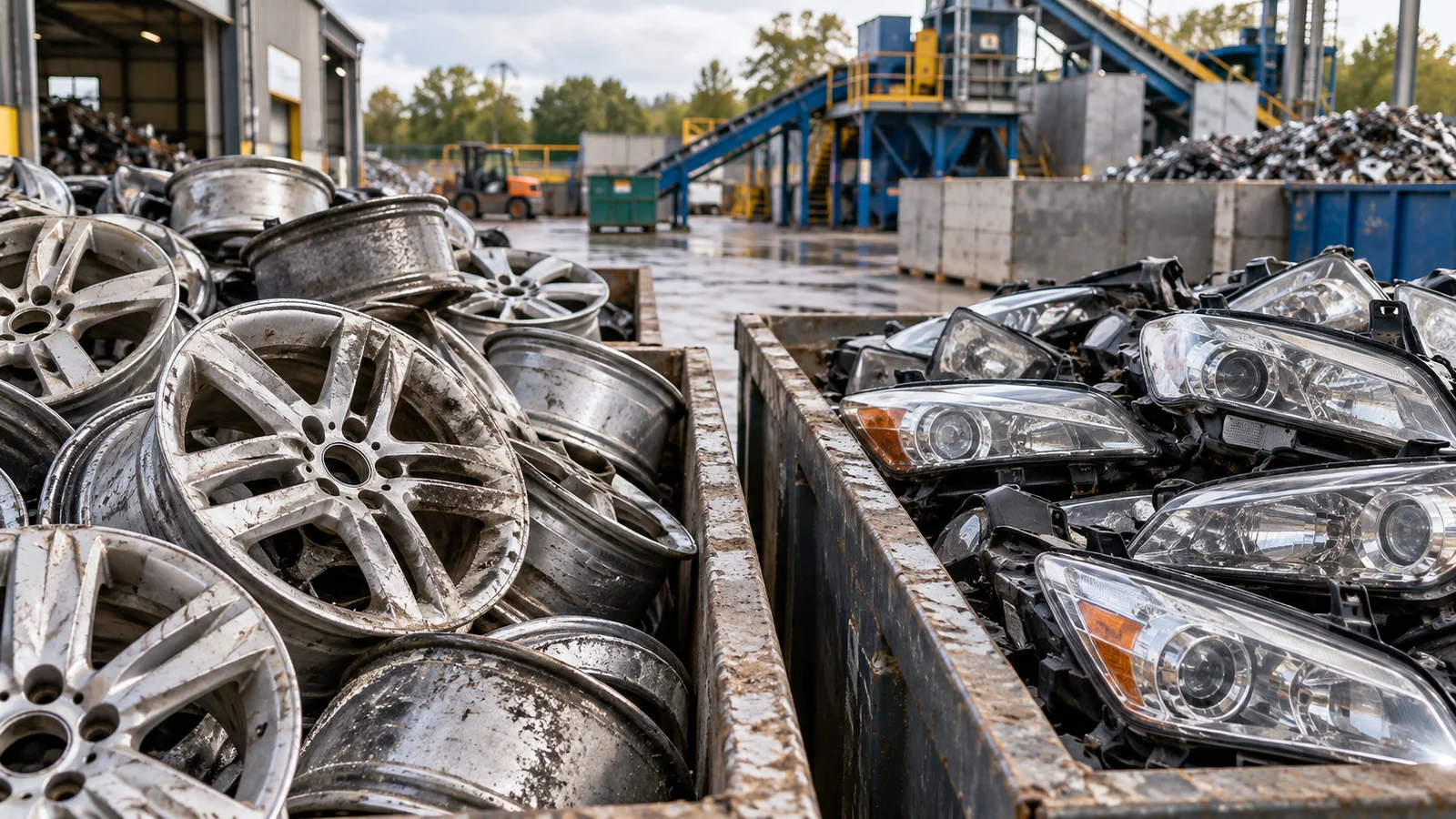
Most garages see the first half of the recycling story: damaged wheels and broken light units pile up in a corner, a van arrives, and the pile is gone. What happens next is worth knowing — partly because your duty of care under section 34 of the Environmental Protection Act 1990 doesn't end when the waste leaves your yard, and partly because these two streams are among the most recoverable things a workshop throws away.
Step one: a documented handover
Every journey starts the same way. When we collect, an electronic waste transfer note (eWTN) is issued before the driver leaves, recording what was taken, when, and by whom. That digital record is your evidence that the waste was passed to a registered carrier — Eco Auto Solutions holds SEPA waste carrier registration WCR/R/3021810, valid across Scotland, England and Wales and verifiable on SEPA's public register. The standard to work to is keeping transfer notes for two years, and an electronic note makes that effortless: nothing to file, nothing to lose.
The alloy wheel route: back to the furnace
Alloy wheels are a gift to recyclers. The aluminium alloy they're cast from can be remelted again and again without degrading, and remelting recovered aluminium takes only a fraction of the energy needed to produce new metal from ore. After collection through our alloy wheel collection service, wheels are sorted and prepared for the metals recovery chain: tyres, balance weights and valves are separated so the clean alloy can go for remelting. From there the metal re-enters manufacturing — the same material, in a new casting.
That's also why scrap wheels should never be buried in a general waste skip. Mixed in with rubbish, the metal is hard to recover economically; kept as a separate stream, it is almost entirely reusable.
The headlight route: hand-stripping before anything else
Headlights take more work. A modern light unit combines several materials in one assembly, which is why they're collected as their own stream through our headlight collection service rather than tossed in with general plastic.
At our Hamilton facility, collected units are stripped by hand. Manual sorting is slower than machinery, but it's the only way to separate materials cleanly: metal fittings, wiring and other unwanted components come out, and the recoverable plastic goes forward for granulation. The resulting material feeds our PP regrind supply back into plastics manufacturing, alongside the output from bumpers and trims. Components that can't become regrind are separated and sent down the correct recovery route — nothing we collect goes to landfill.
Why the destination matters to your garage
Under the duty of care, every workshop handing over controlled waste is expected to take reasonable steps to ensure it's dealt with properly — SEPA enforces this in Scotland, the Environment Agency in England. Knowing your wheels end up remelted and your headlights end up hand-sorted and granulated isn't just reassuring; it's exactly the kind of answer an inspector, an insurer or a fleet customer wants to hear.
There's a practical upside too. Wheels and headlights can be collected on the same visit as bumpers and other plastics, on a weekly, fortnightly, monthly or one-off schedule with no minimum volume — one van, one eWTN, every stream accounted for.
Arrange a collection
We cover all of Scotland and the North of England — including Carlisle, Penrith, Newcastle, Middlesbrough, York, Leeds, Bradford, Manchester and Liverpool. A deliberately limited area so every schedule can be kept. Contact us or call 0141 260 6602 to add alloy wheels and headlights to your collection.
FAQ
Do you collect alloy wheels and headlights together with bumpers? Yes. One visit can cover bumpers, headlights, hard and soft plastics and alloy wheels, all recorded on a single electronic waste transfer note before the driver leaves.
Can damaged or buckled wheels still be recycled? Yes. The wheel doesn't need to be serviceable — the value is in the aluminium alloy itself, which is remelted. Cracked, kerbed or corroded wheels are all suitable for collection.
Do headlights need to be intact? No. Broken lenses, snapped tabs and water-damaged units are all fine. Each unit is stripped by hand, so the condition it arrives in doesn't affect whether the materials can be recovered.
What proof do we get that the waste was handled properly? An eWTN is issued at every collection, giving you a digital record from a SEPA-registered carrier (WCR/R/3021810). Keeping transfer notes for two years is the standard to work to, and electronic notes make that simple.